From: Sustainable Energy Advantage, LLC
<sea-deliverables@seadvantage.com>
Sent: Monday, December 6, 2021 5:54 PM
To: Bob Grace
Subject: SEA New England Eyes & Ears Flash No. 92.5, Week Ending
December 3, 2021
New England
Eyes & Ears Flash 92.5, Week
Ending December 3, 2021
 Top Stories Time-sensitive articles are
identified with the following icon:
Top Stories Time-sensitive articles are
identified with the following icon:
 MA: DPU approves provisional interconnection cost
allocation program for DG in current group studies, including potential
for cost socialization; EDCs propose to socialize up to 100% of
transmission costs, subject to DPU approval; Procedural conference call to
be held December 10
MA: DPU approves provisional interconnection cost
allocation program for DG in current group studies, including potential
for cost socialization; EDCs propose to socialize up to 100% of
transmission costs, subject to DPU approval; Procedural conference call to
be held December 10- MA: ARPA spending bill
funding port development, EV rebates and housing grants with preference
for clean heating and on-site renewables passes in informal sessions,
Baker expected to sign into law
- ME: DEP suspends NECEC permit,
construction halted until Courts reach a determination
- ME: PUC issues 2-stage
RFP for Transmission and Generation in Northern Maine; transmission bids
due March 1, 2022 generation bids due May 1, 2022
- ME: CMP and MREA/CCSA
file briefs on PUC jurisdiction related to cluster studies; reply comment
period extended amidst ongoing settlement negotiations
- NH: Following a mostly
unexplained (and nearly eleven month) delay, PUC rejects utility energy
efficiency plans, ordering dramatically reduced budgets as part of a
transition to "market-based" energy efficiency; CENH prepare to
challenge decision in superior court
- VT: Climate Action Council
approves final Climate Action Plan recommending 100% renewable/carbon-free
electricity by 2030, 100% ZEV sales by 2035, adoption of Clean Heat
Standard, and potential future participation in TCI (or a similar
program); DPS releases draft 2022 Comprehensive Energy Plan with many
overlapping recommendations
- VT: Parties file legal
briefs in case regarding GlobalFoundries petition seeking to become
independent energy utility, exemption from GWSA
- R/N: Vineyard Wind
breaks ground on Vineyard Wind I project
- R/N: Solar Trade
Updates: Federal trade court strikes down tariff on bifacial solar and
reinstates exclusion; International Trade Commission recommends that Biden
Administration extend of solar panel tariffs
Headlines
2021 New England Legislative Tracking Spreadsheet
Update
 DPU approves provisional interconnection cost
allocation program for DG in current group studies, including potential
for cost socialization; EDCs propose to socialize up to 100% of
transmission costs, subject to DPU approval; Procedural conference call
to be held December 10
DPU approves provisional interconnection cost
allocation program for DG in current group studies, including potential
for cost socialization; EDCs propose to socialize up to 100% of
transmission costs, subject to DPU approval; Procedural conference call
to be held December 10- ARPA spending bill funding port development,
EV rebates and housing grants with preference for clean heating and
on-site renewables passes in informal sessions, Baker expected to sign
into law
- DPU issues second Order in investigation of
National Grid management audit: Orders company to implement all audit
recommendations and file comprehensive update with next base rate case
- EDCs respond to stakeholder positions in reply
briefs in SMART tariff review docket; considering some but opposing many
proposed tariff changes
- EFSB opens consolidated docket to
consider multiple petitions for approval of the transmission facilities
in support of Mayflower Wind project
- Anbaric and Borrego protest ISO-NE FCA16
Information filing as it relates to treatment of their energy storage
projects in FCA 16; Borrego requests that battery storage ORTP account
for ITC in pending BBB Act
- Other Massachusetts News of Note
- Stakeholders
comment on new proposed RPS regulation that would implement financial
security requirements for LSEs, potentially change the amount of
allowable REC banking , and stop post-closing REC adjustments in NEPOOL
GIS
- UI submits updates Procurement Plan and
budget for Year 10 LREC/ZREC including previously disqualified 64 Solar
bid
- Other Connecticut News of Note
- National Grid files its recovery factor for
long-term contracting for renewable energy
- OER files recommendations for the 2022
Renewable Energy Growth Program Year with PUC
- FERC Denies Green Development Request for
Rehearing regarding arguments against National Grid DAF charges
- Other Rhode Island News of Note
- DEP suspends NECEC permit, construction halted until
Courts reach a determination
- PUC issues 2-stage RFP for Transmission and
Generation in Northern Maine; transmission bids due March 1, 2022
generation bids due May 1, 2022
- CMP and MREA/CCSA file briefs on PUC
jurisdiction related to cluster studies; reply comment period extended
amidst ongoing settlement negotiations
- Agricultural Solar Stakeholder
Group holds final meeting on December 16, releases draft report
overviewing agricultural siting policies and recommending dual-use pilot
program and incentives to preserve farmland
- 76.5 MW Farmington solar project in Maine has
entered service, will supply power to five New England colleges
- FERC issues NOI to prepare EIS for the four
Kennebec River dams for effects on endangered Atlantic salmon
- Efficiency Maine Trust reports that it
issued 12 awards for installation of 58 Level 2 charging ports in EV
charging pilot
- ReVision submits comments arguing
proposed Versant O&M cost methodology overallocates costs to
interconnecting customers; PUC delays implementation of O&M costs
until February 2022
 Versant submits two Joint Offers of
Settlement between itself and MPUC to resolve issues raised in response
to Versant's Order 864 filing, 2020 annual transmission charges update
Versant submits two Joint Offers of
Settlement between itself and MPUC to resolve issues raised in response
to Versant's Order 864 filing, 2020 annual transmission charges update- CMP files Petition for advisory ruling on
definition of "aggregated generation" when screening for Level
2 interconnections, argues definition should include all generation with
an executed interconnection agreement
- PUC issues advisory ruling denying
Renergetica request for interconnection cost-sharing exemption for level
4 project
- Maine DOT releases Searsport offshore wind
port feasibility study
- Nexamp requests that PUC allow access to
customer records for NEB project sponsors
- PUC issues procedural order denying EV
rate design waivers to small utilities; VBLPD and EMEC respond to order
by updating existing rate schedules to include EV charging
- Efficiency Maine Trust submits petition
for approval of Triennial Plan; Projects three-year energy cost savings
of over $1.57 billion from heat pump, demand management, and electric
vehicle infrastructure measures
- Versant files executed agreement for 40
MW Goose Cove from Tranche 2 procurement
- Versant to restudy steady-state analysis for
Bangor Hydro District cluster study due to more than 20 MW attrition in
the group, study on track for completion in January 2022
- NEB Good Cause Exemption and Discrete Facility
Advisory Ruling trackers updated
- Other Maine News of Note
- Climate Action Council approves final Climate Action
Plan recommending 100% renewable/carbon-free electricity by 2030, 100%
ZEV sales by 2035, adoption of Clean Heat Standard, and potential future
participation in TCI (or a similar program); DPS releases draft 2022
Comprehensive Energy Plan with many overlapping recommendations
- Parties file legal briefs in case regarding
GlobalFoundries petition seeking to become independent energy utility,
exemption from GWSA
- Vermont Supreme Court decision would no
longer require Act 250 permits for projects that disturb less than one
acre of land in towns without zoning; decision opposed by Natural
Resources Board and Council, case to be reargued
- WEG files Petition to build 4.99 MW battery
energy storage system in South Hero
- PUC issues order approving utility 2020 RES
filings
- FERC issues Order modifying Mystic ROE Order
by reducing base ROE to 9.19%: ENECOS and NESCOE challenge Mystic's
informational filing related to its cost-of-service agreement
 FERC releases NOI seeking comment on reactive
power capability compensation, initial comments due January 31, 2022
FERC releases NOI seeking comment on reactive
power capability compensation, initial comments due January 31, 2022- ISO-NE publishes FCM resource terminations
data
- ISO-NE presents revisions to
Transmission 2050 study at PAC Meeting
Regional and National Developments
- Vineyard Wind breaks ground on Vineyard
Wind I project
- Solar Trade Updates: Federal trade court
strikes down tariff on bifacial solar and reinstates exclusion;
International Trade Commission recommends that Biden Administration extend
of solar panel tariffs
- Illinois regulators begin
implementation of CEJA provisions, including provisions related to energy
storage, electric vehicles, and REC procurement
- DOE issues RFI on energy sector supply chain
- Other Regional and National News of Note
2021 New England Legislative Tracking Spreadsheet Update
SEA's most up to date
Legislative Tracking Spreadsheet can be found here. Please feel free to
contact Jim
Kennerly with any questions regarding New England legislative
tracking.
DPU approves provisional interconnection cost
allocation program for DG in current group studies, including potential for
cost socialization; EDCs propose to socialize up to 100% of transmission costs,
subject to DPU approval; Procedural conference call to be held December 10

On November 24, 2021, in Docket 20-75, the Massachusetts Department of
Public Utilities (DPU) issued an Order establishing a provisional cost
allocation program (Provisional Program) to facilitate the interconnection of
distributed generation (DG) currently in the interconnection queue and facing
atypically high interconnection costs.
In addition, on December 3, the DPU issued Notice issuing a correction to a
reference made in the Order and scheduling a conference call to be held on
December 10 at 1:30 pm to answer procedural questions posed by the utilities
concerning implementation of the directives set forth in the Order. The
conference call can be accessed via Zoom here.
As last discussed in Digest 90, Docket 20-75 was established to
consider:
- Distributed energy resource
planning; and
- Cost allocation for system
modifications required to facilitate the interconnection of DG, including
a Straw Proposal .
Specifically, the DPU's Straw Proposal proposed a long-term
planning process to allow for the upfront financing by ratepayers of system
upgrades necessary to accommodate the interconnection of DG. Subsequent
interconnecting DG projects would be charged for the system upgrade costs on a
pro-rata basis, based the ratio of on each project's MW to the total nameplate
MW of interconnection enabled by the system upgrade, and these payments would
be credited to ratepayers. The DPU's November 24 Order did not approve this
long-term process, but rather approved, as the Provisional Program, the
aforementioned cost allocation method for a limited set of near-term system
upgrades, subject to DPU approval for each specific upgrade.
An overview of the DPU's Straw Proposal is provided below for
context, as the Provisional Program utilizes concepts and terminology
established in the Straw Proposal (for an even more detailed summary of the
Straw Proposal, see Digest 85). As noted above, the Provisional Program
mandated in the Order does not incorporate all of the elements of the Straw
Proposal. Distribution System Planning: The DPU proposed that
National Grid, Eversource and Until individually undertake distribution system
planning efforts on an annual basis, with the goal of identifying system
upgrades necessary to accommodate forecasted load growth and DG interconnection
on a rolling ten-year basis. Cost Allocation Proposal for “Capital
Investment Projects” based on Distribution System Planning Process: The
DPU proposed that the planning process or interconnection studies would
identify distribution system modifications (referred to as "Capital
Investment Projects" (CIPs)) that, if approved, would be funded by the EDC
using a Reconciling Charge to be included as a part of the distribution charge.
Each DG facility benefiting from a CIP would then be charged an upfront $/kW
fee (calculated as a proportional share of the cost of the modification relative
to the total kW capacity the modification can enable to interconnect), which
would be credited to the Reconciling Charge to offset the costs borne by
ratepayers. The total annual Reconciling Charge would be capped at 1.5% of the
EDC's total yearly revenue (or a greater amount determined by the DPU). Though
not explicitly stated, the presence of the limit implied that if the limit is
reached (and not expanded by the DPU), the DPU would cease qualifying CIPs for
up-front ratepayer funding. The proposal would reduce individual DG project
exposure to footing the entire cost of a modification faced by each project as
it seeks to interconnect, instead spreading upgrade costs evenly over current
and future DG projects that would benefit from the modification, while having
ratepayers initially fund the upgrade costs . Preemptive construction of such
facilities would also accelerate and streamline the interconnection process.
A summary of the DPU's Order, organized by issue area, is provided
below:
- CIP Eligibility: The
DPU required that CIPs under the Provisional Program must be identified
and proposed based on the cost allocation and cost recovery methodology
set forth in the Straw Proposal and must fulfill the following additional
requirements (emphasizing that the Order does not pre-approve any CIPs):
- Eligible Studies: The
DPU restricted eligible CIPs under the Provisional Program to only system
upgrades resulting from the currently identified group studies (discussed
in the Docket), as the high $/kW system upgrade costs of these projects
generated the need for the Provisional Program. The DPU estimates that
these studies impact roughly 1 GW of DG.
- Shared DG Benefits: Eligible
CIPs must benefit multiple DG facilities and cannot benefit only a single
facility.
- Maximum CIP Fee: The
DPU found that, based on a review of cost information provided by the
EDCs and stakeholders, developers are rarely able to pay in excess of
$500/kW in interconnection costs. Given this, the DPU limited eligible
CIPs in the Provisional Program to those that would result in a maximum
fee of $500/kW. For example, if a system upgrade would enable 10 MW of
DG, but would cost $10,000,000, and would have 0% of its costs
socialized, the resulting CIP fee for such an upgrade would be $1,000/kW.
In such a case, the CIP fee would be in excess of the DPU’s maximum fee,
and the CIP would be ineligible. In doing so, the DPU reasoned that CIPs
that would result in a fee in excess of $500/kW would be unlikely to have
all their enabled DG capacity utilized, and would therefore result in CIP
fees not fully reimbursing the system costs initially funded by
ratepayers. As discussed in Digest 89, National Grid and Eversource
anticipate that projects involved in their current group studies could
face costs as high as $2,000/kW, but that if the system upgrades were
approved as CIPs, the costs could be as low as $300/kW. As such, it is
our expectation that this eligibility criteria would not exclude the
majority of CIPs proposed.
- CIP Capacity Utilization: To better ensure that the capacity of system
upgrades is fully utilized and ratepayers are made whole by CIP fees from
interconnecting projects, the DPU required that EDCs must identify the
specific geographic area served by the upgrades and "demonstrate
that the amount of enabled DG likely will be interconnected in that
geographic area within the proposed Rate Recovery Period." The DPU
did not provide details regarding how an EDC would demonstrate this.
- Interconnection Construction Timelines: In addition to higher-than-average system
upgrade costs, National Grid and Eversource Energy report that system
upgrades necessary to accommodate the DG currently being studied would
take between two to five years to construct. The DPU found that, in the interest
of ensuring that the capacity of system upgrades is fully utilized, it is
necessary to limit eligibility to CIPs "for which the construction
timeline provides a likelihood that the DG facilities currently in the
interconnection queue will be able to remain viable and interconnect
following completion of the EPS upgrades." As such, the DPU required
that eligible CIPs must demonstrate that the aspects of the construction
timeline within EDC control can be completed within a maximum of four
years from the DPU approval. The DPU also urged the EDCs to "use
commercially reasonable efforts to accelerate procurement and
construction schedules for completing these upgrades."
- CIP Identification and Approval Process: The DPU provided the following process for CIPs
to be identified and proposed:
- Following the completion of a distribution and/or
transmission group study, the applicable EDC must notify all group
members and the DPU via a letter filed in Docket 20-75.
- After notification is given, the EDC has ten business
days to determine if any upgrades identified in the analysis will be
proposed as a CIP, and must inform the DPU and group members of its
determination. For Group Studies that were completed prior to issuance of
the Order (see Digest 89 for a discussion of recently-completed
Eversource studies), the DPU specified that the Completion Date will be
the tenth business day following the date of the Order (December 8). As
such, the EDCs will have until December 22, 2021 to propose CIPs
resulting from already-completed studies with the DPU.
- Following this determination, the EDC will have 40
business days to file a CIP proposal with the DPU.
- Cost Socialization: As
discussed in Digest 89, National Grid has proposed to allocate 40-60% of
distribution-side DG interconnection costs to all customers, meaning that
this portion of costs would not be charged/reimbursed on the pro-rata
basis discussed above but would be borne entirely by ratepayers.
Eversource has also agreed that socialization of a portion of distribution-side
costs is desirable, but proposed specific ratios be determined on a
case-by-case basis. Notably, National Grid proposed to socialize 100% of
costs associated with transmission line upgrades (with transmission-side
substation upgrades still being funded in part through CIP fees) and
Eversource proposed to socialize 100% of transmission related upgrades
(with no distinction between substation and line upgrades), arguing that
such improvements to the transmission system will benefit all ratepayers
and are thus suitable for socialization. If implemented, the socialization
of these transmission costs could dramatically reduce project attrition
for projects included in Affected System Operator (ASO) studies, which
have implicated roughly 1.5 GW of proposed projects to date and resulted
in higher-than-average interconnection costs for many impacted projects.
The DPU noted that, despite the EDC's willingness to socialize a portion
of system upgrades based on analysis of the shared benefits to broader
ratepayers that the upgrade would provide, the DPU is unable to determine
whether it would be "consistent with the public interest for any CIP
costs to be borne solely by distribution customers." As such, the DPU
intends to evaluate the socialization of system upgrade costs on a
case-by-case (i.e., CIP by CIP) basis. As such, the DPU directed CIP
proposals to include:
- Detailed descriptions of each component of a CIP that
it proposes to recover solely from ratepayers; and
- A justification for why the costs of the CIP should be
recovered from ratepayers and not from Interconnecting Customers.
- Customer Notice Period: The DPU found that, to provide regulatory
certainty to developers facing uncertain interconnection costs pending DPU
ruling on CIPs, the "Notice Period" (in which a customer must
provide the EDC with determination as to whether they will proceed with
the interconnection process) for Group Studies in which the EDC has
submitted a CIP for DPU review will be 15 business days from the issuance
of the DPU's Order on the applicable CIP. As discussed above, there are a
number of already-completed studies in Eversource’s service territory,
which, as discussed in Digest 89, were given an indefinite extension (via
a May DPU Order) on their deadline to determine if
they will proceed with the interconnection process until “further
resolution is found through this [Docket 20-75] investigation.” Given the
DPU’s Order establishing the Provisional Program could be considered
“further resolution” in the Docket, and that the system upgrades resulting
from such studies have not yet been proposed as CIPs for DPU review, it is
unclear if that extension is still in effect.
Analysis and Next Steps Given that the Provisional
Program was established with the express intent to address high interconnection
costs resulting from these very studies, it is our expectation that many
projects already in complex studies with functionally unaffordable upgrades for
individual developers will be included in proposed CIPs, and will likely have
their extension remain in effect until the EDCs propose such CIPs (assuming
they do, given a lack of requirement to do so). At that point, the Order’s
revisions to the Notice Period will take effect and provide the projects with
an extension through 15 days from the DPU’s eventual order on such CIPs.
That said, and given that 1) our team is unaware of the extent of
CIPs the EDCs will propose and 2) the EDC are not required to propose any CIPs
at all, it is difficult to evaluate how impactful this Order will be for the
hundreds of MW of projects already involved in complex and costly studies for
which a departure from traditional cost allocation approaches is likely
necessary to avoid mass attrition.
In addition, the four-year maximum timeline for CIP construction
appears likely to conflict with the fact that all projects seeking the federal
Investment Tax Credit (ITC) under current law must have all projects “placed in
service” (PIS) no later than December 31, 2025, or must accept a 10% tax credit
value. As such, if the Build Back Better Act (most recently discussed in
Special Flash 92.4.1) or similar legislation extending the PIS deadline
ultimately is not enacted, such a timeline is also very unlikely to prevent
attrition amongst projects with tax equity investors who will not be satisfied
with the uncertainty regarding their ability to monetize the credits. Perhaps
most importantly, it is unclear the pace at which CIPs will be proposed and
adjudicated by the DPU, given a lack of deadlines to issue determinations once
CIP proposals are filed, as well as the constraints on EDC and DPU bandwidth to
study and rule on CIPs. We note, for example, that the tariffs to expand the
SMART program have been pending before the agency for more than a year. If such
rulings follow even a fraction of that timeline, it is our understanding that
these delays, coupled with the tax credit uncertainty (especially in the case
that the Build Back Better Act does not pass), could drive even more
significant attrition than the amounts already occurring in those cohorts group
study cohorts under consideration will be unavoidable. It is also unclear if
the EDCs or DPU will collectively prioritize (or possess the bandwidth to
prioritize) the development, review and approval of proposed CIPs on timescales
conducive to the successful development of these projects.
Given the issuance of an Order on the short-term provisional
program, the next steps in this proceeding beyond the aforementioned conference
call appear to be the issuance of an order on the long-term planning process
described in the DPU's Straw Proposal, although it is possible that defining a
long-term approach to allocating DG interconnection costs could be separately
docketed. The DPU has not indicated when such an order could be expected.
ARPA spending bill
funding port development, EV rebates and housing grants with preference for
clean heating and on-site renewables passes in informal sessions, Baker
expected to sign into law
On December 1, 2021, the conference committee of the Massachusetts
General Court negotiated a consensus bill to allocate American Rescue Plan Act
and state surplus funds last discussed in Flash Update 92.4, released H.4269-
An Act relative to immediate COVID-19 recovery needs for
final passage for enactment. The final bill allocates funds to a number of
efforts relating to renewable energy, which we summarize below.
- $90 million for the
Massachusetts Offshore Wind Industry Investment Fund to be used for port
infrastructure development for the offshore wind industry, with an earmark
of $10 million for the North Jetty and associated infrastructure at the
South Boston marine multiport;
- $115 million to produce
for-sale, below-market-rate housing for first-time homebuyers and
disadvantaged communities with a grant preference for, among other things,
"projects that include clean energy and sustainability initiatives,
such as electric heat pumps, net-zero developments, Passive House or
equivalent energy efficiency certification and all-electric buildings;"
- $6.5 million for a pilot
program for low- and moderate-income housing energy efficiency, clean
heating, and on-site renewables in gateway cities;
- $7.5 million for two-year
colleges that are “minority-serving institutions” to train underserved
populations for “green jobs”;
- $5 million for the
Massachusetts Clean Energy Technology Center for a "research team to
oversee, collect and analyze data" on networked geothermal
demonstration projects approved by the Department of Public Utilities;
- $14 million for grants to the
agricultural, commercial fishing, and cranberry-growing industries
administered by the Department of Energy Resources, to be used for, among
other things, energy efficiency capital improvements and the purchase or
expanded use of renewable energy technologies;
- $1.5 million earmarked for
"facility improvements at the University of Massachusetts Water and
Energy Testing Facility;"
- Authorization for the
Commissioner of Energy resources, subject to the approval of the Secretary
of Energy and Environmental Affairs, to spend Regional Greenhouse Gas
Initiative (RGGI) Auction Trust Fund money on transportation
electrification rebates in Green Communities through June 30,
2022. No less than $27 million shall be spent on the program each fiscal
year, and rebates must be between $2,500-$5,000 per electric vehicle, fuel
cell electric vehicle, and zero-emissions vehicle that costs $50,000 or
less.
On November 2, 2021, the House of Representatives passed H.4269 in
an informal session, meaning there was no roll call vote and no member objected
to passage. On November 3, 2021, the Senate also passed the bill in an informal
session on November 3, 2021. The bill is now before Governor Baker for his
signature or veto. Given Governor Baker’s past statements expressing
frustration with the delay of this bill’s passage, we expect Governor Baker to
sign the bill into law. As there is an emergency preamble to the bill, the law
will go into effect immediately upon signing. The next step after signing would
be the disbursement of the funds.
DPU issues second Order in investigation of
National Grid management audit: Orders company to implement all audit
recommendations and file comprehensive update with next base rate case
On November 24, 2021, in Docket 19-117, the management audit of
National Grid, the Massachusetts Department of Public Utilities (DPU) issued an Order that summarized the audit findings,
addressed the responses of the parties, and directed National Grid to implement
the audit recommendations. Many of the audit findings and recommendations
relate to internal National Grid processes not directly related to renewable
energy, however, the audit addressed National Grid's electric vehicle (EV)
program and interconnection process around the transmission system impact
studies (also called cluster studies or affected system operator (ASO)
studies), which are relevant to renewable energy development and demand.
In examining the EV program, the audit found that while National
Grid tracks useful metrics already, "...additional metrics aimed at early
identification of any issues that may arise would be beneficial...." In
particular, the audit observed that National Grid's 2018 restructuring "led
to a loss of 25 percent of the EV program staff" and recommended that
National Grid increase employee retention in the program by developing goals
for employees in their annual reviews.
On the topic of the interconnection and cluster studies, the audit
found that National Grid was overwhelmed by interconnection applications, and
the decision to create an application portal while some interconnecting
customers where in the midst of applying for interconnection added to the
confusion. High employee turnover at National Grid also contributed to problems
faced by project developers applying for interconnection, and developers also
"expressed frustration at dealing with multiple job owners for multiple
projects across different geographic regions, often leading to conflicting
information." The audit recommended that National Grid track responses to
developers and attempt to address the root causes of these issues.
The DPU ultimately ordered National Grid to implement all of the
recommendations of the audit "in a timely, efficient, and prudent
manner." The DPU noted that National Grid has not proposed a plan to
address each recommendation, and that the timeframes provided by National Grid
for addressing many of the recommendations are "unclear." The DPU
clarified that it will assess National Grid's investments in implementing the
recommendations for prudency and urged National Grid to accelerate solution
timelines where feasible.
National Grid will file a comprehensive update on its
implementation of the audit recommendations when it files its next base rate
proceeding, the timing of which is currently unclear.
EDCs respond to stakeholder positions in reply
briefs in SMART tariff review docket; considering some but opposing many
proposed tariff changes
As last discussed in Flash Update 92.4, on October 25, 2021, the
Massachusetts Department of Public Utilities (DPU) issued a Memorandum in Docket 20-145, the
proceeding in which the DPU is considering the electric distribution companies’
(EDCs) Revised SMART Tariff and Petition for Approval of the Revised SMART Tariff,
requesting comments relating to Phase II of the SMART Tariff review. Phase II
of the Tariff review is considering provisions pertaining to metering, billing,
Alternative On-Bill Credit (AOBC) allocation (including the transfer of AOBCs
between Eversource’s eastern and western service territories), revisions to
certain definitions, and National Grid’s Solar Access Initiative (SAI) proposal
(see Digest 88). Phase I of the Tariff review considered all necessary
revisions to allow for the 1,600 MW program expansion, and is currently
awaiting an order from the DPU.
The Memorandum requests that parties provide responses to the
following questions (listed verbatim):
- Where the competitive electric
suppliers and municipal load aggregators operate in the same electric
supply market, is it in the public interest for a ratepayer-funded program
to provide for the allocation of credits only through a municipal load
aggregation program and not also through competitive electric suppliers?
- Are there requirements of the
Climate Act related to unused AOBCs and to the SMART Program that should
be incorporated into the SMART Regulations and, subsequently, included in
the model SMART Provision for the Department’s approval of a fully
integrated model SMART Provision?
- Are there any requirements
within existing law mandating uniformity of elements of an [Low Income
Community Shared Solar] program to be administered by a Distribution
Company?
Initial comments were discussed in Flash Update 92.4. On November
23, Eversource Energy and National Grid (the EDCs) filed their Joint Reply Brief. A summary of the arguments
made in the brief (with references to relevant arguments to which the EDCs are
replying) is provided below, organized by topic:
- Metering: DOER,
AGO and SEIA argued that the DPU should not approve prescriptive metering
terminology in the SMART Provision, arguing that the EDC's current
metering requirements are too restrictive. In response, the EDCs argued
that the metering requirements proposed are not overly restrictive, and
that SEIA has yet to raise any substantive issues with the requirements as
proposed. In addition, the EDCs opposed DOER’s suggestion to allow
customer-owned inverter-based metering to be used for revenue or SMART
Incentive Payment purposes. The DPU’s position on this question will have
notable cost implications for smaller projects.
- ESS Operational Restrictions: As discussed in Flash Update 91.6, the Tariff
provides that for DC-Coupled Solar Tariff Generation Unites (STGUs) paired
with Energy Storage System (ESS), the customer may not charge the ESS from
the STGU during any period that interferes with the EDCs ability to
participate in markets or incentive programs in which the EDC is entitled
to participate. DOER, AGO, Zero Point, and SEIA opposed such provisions, arguing
that SMART and Clean Peak Energy Standard (CPS) regulations already
provide operational restrictions, that the EDCs have not historically
participated in such programs, and that EDCs do not project significant
revenue from such participation. In response, the EDCs argued that it is
their obligation to maximize value to ratepayers, and that the provision
is necessary to protect the EDCs’ rights to STGU capacity and clean peak
attributes. Furthermore, the EDCs argued that SEIA has failed to
demonstrate that the restrictions would hinder the deployment of
DC-coupled ESS in the Commonwealth.
- Delivery Charges for ESS: SEIA and AGO opposed the inclusion of a delivery
charge, including demand charges, for Standalone STGUs and Standalone
STGUs paired with ESS, arguing that it is inappropriate to apply a demand
charge designed for typical customers to these resources. The EDCs argued
that the DPU should approve their proposed language which would allow the
EDCs to determine the appropriate delivery charge for STGUs paired with
ESS. In doing so, the EDCs opposed the AGO’s argument that applying demand
charges to ESS charging from the grid is inappropriate because ESS is
unlikely to contribute to peak demands, arguing that the AGO has not
presented evidence to support this conclusion. The EDCs argued that there
is currently an insufficient number of energy storage systems to merit a
distinct ESS delivery charge. We note that other states, such as
Connecticut (discussed in Flash Update 92.4) have introduced or are contemplating
tariffs specific to standalone storage that do not include demand charges.
- Statement of Qualification (SOQ) Requirements: In response to the AGO and SEIA’s opposition to
language that would require submission of the Payment/Credit Form to the EDC
before DOER can issue a Statement of Qualification for the corresponding
STGU, arguing that the Tariff should not govern when DOER can issue an SOQ
or place preconditions on that process, the EDCs noted that DOER supports
the provision and claimed that the revision would reflect the current
practice.
- AOBC Payment/Credit Form:
- SEIA requested that the DPU require the EDCs to allow
for monthly updates to Payment/Credit Forms, as opposed to the proposed
timeframe of every 3 months, arguing that the EDCs currently possess the
capability to do so. In response, the EDCs argued that SEIA has failed to
demonstrate that allowing for updates once a quarter would impede the
development of community shared solar. In addition, the EDCs argued that
the costs of allowing for monthly updates would be significant and would
be passed onto ratepayers.
- In response to the Tariff's proposed definition of a
complete AOBC Payment/Credit Form as a form in which “allocations
correctly total 100 percent to active and valid Customer accounts and
there are no billing account number or customer name errors,” DOER, AGO,
and SEIA recommended aligning the SMART Provision with DOER’s SMART
Regulations and guidelines by requiring 90% allocation. The EDCs stated
willingness to revise the requirement, but clarified that any unallocated
credits will go to the host account by default and be subject to any
“cash out” provisions approved in this proceeding.
- Unused AOBCs: As
discussed in Digest 89, the Tariff revisions would allow AOBCs to be
carried forward beyond the billing month. The EDCs propose to treat such
"Unused AOBCs" (for which the EDCs propose to create a new
definition in the regulations) in a manner that appears to be very similar
to the way in which eligible customers can carry forward net metering
credits.
- SEIA and AGO opposed provisions putting the cash-out
of AOBCs at the EDCs’ discretion. In doing so, they argued that Section
96 of Chapter 8 of the Acts of 2021 (see
Digest 88) directs the EDCs to purchase all or a portion of credits
generated from solar project participating in SMART with a commercial
operation date after January 1, 2021. As such, SEIA argued that the
Tariff should be amended to allow AOBC cash-outs at the project owner's
discretion (as opposed to the EDCs' discretion), applicable to all
facility types (as opposed to just Standalone facilities). In response,
the EDCs requested clarification from DPU regarding how it interprets the
applicability of the statute, raising multiple questions regarding how
current law would affect AOBC cash-outs.
- In addition, SEIA proposed a cash-out provision that
would result in the full value of AOBCs being provided to project owners
who elect to cash-out their AOBCs, arguing that the Tariff's provisions
that assign cash-out value based on ISO-NE Locational Marginal Pricing
(LMP) violates Section 96's requirement that the purchase of credits be
completed "at the rates provided for in the applicable statute,
regulation, or tariff without discount, fee, or penalty." In
response, the EDCs argued that the proposal lacks the necessary details
to be considered a valid recommendation, would be unnecessarily
complicated, could present gaming risks if the value of cash-outs exceeded
the value of allocating credits to subscribers, and that it was unclear
if the statute cited should apply to AOBCs. We note that, given that
Section 96 specifically does not apply to net metering credits (and that
there are no other specific types of non-REC energy-based credits created
by distributed generation (DG) projects), the statute’s mention of
“credits” strongly suggests that it is referring to AOBCs.
- AOBC Transfer: SEIA
argued that the combination of capacity blocks for Eversource East and
West (as currently reflected in SMART Regulations) should be reflected in
the Tariff. In addition, SEIA requested that the limitation on the
transfer of AOBCs between Eversource East and Eversource West be
eliminated and argued that such transfer is required by Chapter 8 of the Acts of 2021. Eversource
explained that it is currently undergoing improvements to its billing system
which would make such transfer possible, but did not provide a timeline
for the completion of such upgrades.
- True-up Payments for Storage Losses: DOER proposed clarifying edits to language that
implement its true-up payments for storage losses unique to DC-coupled
ESS. The EDCs (in addition to SEIA, in initial testimony) supported the
implementation of such true-up payments.
- National Grid Solar Access Initiative (SAI): As discussed in Digest 88, National Grid has
proposed a SAI program. National Grid's SAI consists of two components.
First, National Grid proposes to implement Solar Simplified Billing (SSB),
a voluntary method of streamlining billing for Community Shared Solar
(CSS) or Low-Income Community Shared Solar (LICSS) facilities
participating in the SMART program. Second, National Grid proposes to
implement a Solar Enrollment Program (SEP), in which National Grid would
handle both customer acquisition and management for low-income customers
(defined as those on Rate R-2). Voluntary participation in either program
would require the payment of fees to cover administrative costs (for both
SSB and SEP) and costs associated with LMI benefits (for SEP only).
- SEIA and the Low-Income Weatherization and Fuel
Assistance Program Network opposed both the SSB and SAI on the basis that
the fees required for participation would not benefit low-income
customers and would violate Section 96 of Chapter 8 of the Acts of 2021, which (as
discussed above) requires that the purchase of credits from a facility
owner by an EDC be made "without discount, fee, or penalty." In
addition, SEIA argued that the SAI should only apply to low-income
customers because National Grid has not demonstrated a market failure for
non-low-income customers that would require intervention, whereas the SAI
as proposed would make SSB available to non-low-income customers. In
response, National Grid argued that the current SMART program has failed
to deliver benefits to low-income customers, and that its proposal would
only increase the number of voluntary options that developers could draw
from in reaching low-income customers. In addition, National Grid
defended fees for participation in its program, arguing that National
Grid would be providing a service to developers in either program, and
thus would reasonably deserve compensation for the service.
- AGO objected to National Grid's 10% performance
incentive mechanism (PIM) for enrolling customers in the SEP program and
objected to the SSB Facility Fee. More generally, the AGO raised concerns
with the lack of stakeholder input in the development of the proposal and
the proposal's complexity. In response, National Grid provided evidence
of stakeholder engagement conducted to inform the program design, and
argued that the PIM is reasonable and in line with meeting the Commonwealth’s
policy goals.
- Eversource Community Solar Access Program:
- In response to SEIA’s request that the DPU require
Eversource to refine its proposed RFP process to reduce the potential for
non-low-income customer being removed from their community solar arrangement
as a result of the RFP's current preference for low-income offtakers,
Eversource stated that it plans to monitor this dynamic and make
appropriate adjustments as a component of its program review process.
- AGO supported the proposal, but suggested that only
the portion of a project that is allocated to low-income Subscribers be
counted towards the program's 234 MW cap. In response, Eversource
expressed willingness to revise its calculation of the program cap, but
noted that doing so would increase the number of projects participating
in the program, and may require expensive billing upgrades to accommodate
the increased volume. In addition, the AGO recommended that Eversource
revise its proposed bid preference from preferring facilities located
within a neighborhood or census block identified as an Environmental
Justice Population to facilities where developers have "support from
the community, have sought input from stakeholders, and/or have
incorporated feedback from the particular community where a developer
proposes to locate a facility." In response, Eversource expressed
willingness to make adjustments to its bid preference, but did not agree
to adopt the recommendations outright.
- Responses to briefing questions (listed above):
- Question 1 (is it in the public interest for a
ratepayer-funded program to provide for the allocation of credits only
through a municipal load aggregation program and not also through
competitive electric suppliers?): The
EDCs stated that they would defer to DPU’s judgement on this question,
but noted that they do not intend to exclude customers receiving energy
from a competitive supplier in their community solar offerings.
- Question 2 (Are there requirements of the Climate Act
related to unused AOBCs and to the SMART Program that should be
incorporated into the SMART Regulations and, subsequently, included in
the model SMART Provision for the Department’s approval of a fully
integrated model SMART Provision?): As
discussed above, the EDCs argued that there are ambiguities in Section 96
of the Climate Act that require interpretation and guidance by the DPU
before changes can be made in the SMART Tariff.
- Question 3 (Are there any requirements within existing
law mandating uniformity of elements of an LICSS program to be administered
by a Distribution Company?): The
EDCs noted that that there are no requirements that EDC proposals
implementing low-income programs under SMART be uniform.
The remaining deadlines for submitting briefs are as follows:
- December 8, 2021 - Deadline for Intervenors to file reply briefs;
and
- December 22, 2021 - Deadline for Electric Distribution Companies to
file reply briefs.
EFSB opens consolidated
docket to consider multiple petitions for approval of the transmission
facilities in support of Mayflower Wind project
On November 17, 2021, the Massachusetts Energy Facilities Siting
Board (EFSB) opened Docket EFSB21-03 to consider petitions
from Mayflower Wind relating to the
construction and permitting of transmission facilities in support of Mayflower
Wind’s proposed offshore wind project in Lease Area OCS-A 0521. Mayflower Wind
is a joint venture between Shell and Ocean Winds (itself a joint venture of EDP
Renewables and ENGIE). Along with the petitions, Mayflower Wind filed a letter requesting that the petitions be
considered in a consolidated proceeding, a request which the EFSB has honored
with the establishment of Docket EFSB21-03.
Specific petitions under consideration include:
- Section 69J Petition, which requested
approval for the new transmission lines and a new substation.
- Section 72 Petition, which requested a
determination that proposed offshore and onshore project construction
components are necessary, serve public convenience, and are consistent
with the public interest.
- Zoning Petition, which requested specific
zoning exemptions from the operation of the Zoning Bylaw of the Town of
Falmouth, Massachusetts.
As last discussed in Special Flash Update 92.1.1, in 2020 the
Department of Public Utilities issued an Order approving power purchase
agreements (PPAs) with the electric distribution companies Eversource, National
Grid, and Unitil, following the selection of Mayflower Wind’s 804 MW "Low
Cost Energy Project" submitted in response to the Section 83C Round II Request for Proposals. On
November 1, the Bureau of Ocean Energy Management (BOEM) published a Notice of Intent to prepare an Environmental
Impact Statement (EIS) for the proposed Mayflower Wind project, which as
proposed would interconnect at locations in Falmouth and Somerset,
Massachusetts. The comment period for scoping the EIS closed on December 1, and
BOEM’s current schedule anticipates announcing the
notice of availability of the draft EIS in January 2023, with expectations to
make the final EIS available to the public in September 2023.
Anbaric and Borrego
protest ISO-NE FCA16 Information filing as it relates to treatment of their
energy storage projects in FCA 16; Borrego requests that battery storage ORTP
account for ITC in pending BBB Act
On November 24, 2021, Anbaric Development Partners, LLC (Anbaric) and Borrego Solar Systems, Inc. (Borrego) filed
with FERC separate Protests and Requests for Expeditious Action regarding
treatment of their respective energy storage projects in Forward Capacity
Auction #16 (FCA 16) for the 2025-2026 Capacity Commitment Period (CCP). The
protests were in response to ISO-NE's November 9 FCA 16 Informational Filing in Docket
ER22-391 discussed in Flash Update 92.4. ISO-NE's Informational Filing included
data for FCA 16 including determinations made by the Internal Market Monitor
(IMM) regarding the requested offer price from each new resource.
Westover Energy Storage Center: Anbaric submitted for
IMM review a New Resource Offer Floor Price for FCA 16 for its Westover Energy
Storage Center, a proposed 100 MW battery storage project located in Ludlow,
MA. The IMM rejected its Offer Floor Price (which is confidential), instead
requiring the project to bid into FCA 16 at a level no lower than the Offer
Review Trigger Price (ORTP) for a lithium-ion battery storage project of
$2.601/kW-mo. Anbaric requested that FERC override the IMM determination and
allow the Westover Project to bid into FCA 16 at its original proposed Offer
Floor Price. Anbaric requested that FERC issue an order addressing their
protests by January 21, 2022.
Wendell Energy Storage Project: Borrego submitted a New
Capacity Qualification package for FCA 16 for its Wendell project with a
confidential requested Offer Floor Price that assumed at 26.2% applicable
Investment Tax Credit (ITC) based on expected passage of the Build Back Better
(BBB) Act by the end of the year. As summarized in Flash Update 91.2 and last
covered in Flash Update 92.4, the BBB Act, which passed the U.S. House of
Representatives on November 19, includes a 30% energy storage ITC,. The Wendell
Project is a proposed 100 MW, 400 MWh (4-hour) battery storage project located
in Wendell, MA. The project intends to sell Clean Peak Energy Credits under the
newly established Massachusetts Clean Peak Standard. However, the IMM mitigated
the assumed 26.2% value to 0% on the basis that the ITC assumption was
speculative. Borrego argued that should a change in tax law provide them access
to an ITC prior to FCA 16, that most or all battery storage project bids will
no longer reflect prevailing market conditions. Borrego requested that FERC
issue a response no later than January 23, 2022 that:
- Finds any passage of
legislation creating a battery storage ITC to be a material change in
prevailing market conditions under ISO-NE Tariff Section III.A.21.2(b)(i);
- Directs the IMM, pursuant to
Tariff Section III.13.8.1(d) to update Borrego (and any similarly situated
storage resources') Offer Floor Price to reflect a battery storage ITC in
FCA 16 if legislation has passed prior to January 23, 2022; and
- Direct ISO-NE to update the
applicable ORTP prior to FCA 17 to reflect the change in tax law creating
a standalone storage ITC.
If FERC rules in favor of Borrego, it could immediately enhance
the economics for energy storage projects with bids accepted for participation
in FCA 16 and future FCAs. FERC has yet to respond to either protest.
Other Massachusetts News
of Note
- SunPower launches Virtual Power
Plant deal for ConnectedSolutions customers, allowing customers with
energy storage to contribute to grid stability: On November 16, 2021, SunPower launched a Virtual Power Plant (VPP)
solution, allowing customers of its SunVault energy storage service to get
paid when utilities use their stored energy during times of peak demand.
Their first VPP offering is being delivered through ConnectedSolutions,
which is available to qualifying Eversource and National Grid customers in
Massachusetts, Rhode Island and Connecticut. Enrollment is open now.
Stakeholders comment on new proposed RPS
regulation that would implement financial security requirements for LSEs,
potentially change the amount of allowable REC banking , and stop post-closing
REC adjustments in NEPOOL GIS
On November 17, 2021, in Docket 19-10-26, several stakeholders filed
comments on PURA-proposed Renewable Portfolio Standard (RPS) modifications . As
discussed in Flash Update 91.7, on October 15 the Connecticut Public Utilities
Regulatory Authority (PURA) issued a Notice of Intent to amend the Renewable
Portfolio Standard (RPS). The proposed regulation is intended to update the RPS
to reflect changes made to Conn. Gen. Stat. § 16-245a pursuant to Public Act
17-186, An Act Concerning Renewable Portfolio Standard Compliance
Requirements (discussed in Digest 79). =The proposed regulation
effectively requires EDCs to independently manage their NEPOOL GIS RECs,
maintain security with PURA to cover certain financial shortfalls, provide
final load settlement data to PURA before a specific date, change (and possibly
eliminate) the amount of RECs that could be banked and used for compliance in
future years, and remove the provisions that allowed for renewable energy
trading of emission attributes. The below stakeholders filed comments:
- United Illuminating Company (UI)
- Constellation Energy
- Vistra and Calpine
- Eversource Energy (Eversource)
- Connecticut Office of Consumer Counsel (OCC)
- NRG
- Retail Energy Supply Association (RESA)
The comments addressed a number of key themes described below:
Timing of Compliance Filings for EDCs vs. Electric Suppliers: The
proposed regulations would require electric suppliers to complete their NEPOOL
GIS settlement by June 15. NRG argued that electric suppliers can’t correct
discrepancies if they receive EDC load data after this date. NRG argued that
PURA should adopt a reporting process like that used by the Massachusetts
Department of Energy Resources (MA DOER) and further proposed PURA adopt the
following three recommendations.
- Require EDCs to provide annual
RPS load obligation for each electric suppliers by May 1 each
year;
- Give electric suppliers a
defined time period to validate or challenge the accuracy of the load
obligation values (within 5 days) with the EDCs; and
- Once the load obligation is
validated and accepted by each supplier and EDC, use those load obligation
values as the basis of the supplier’s annual RPS compliance obligation,
consistent with past practice.
NRG argued that these would help suppliers better manage their RPS
compliance obligation and reduce Alternative Compliance Payments (ACP) because
they could address REC shortfalls while the trading period is still open.
Vistra, Calpine and RESA contended that PURA should maintain an RPS compliance
reporting date that does not change from year to year, and further supported
the current date of October 15 each year for suppliers to submit their
compliance reporting, and a May 15 deadline for EDC reporting of a supplier’s
total load. UI argued that August 15 should be the earliest date that electric
suppliers can submit compliance filings, arguing that this date would give
participating entities enough time to prepare compliance filings after the
NEPOOL GIS settlement date of June 15. Eversource requested that PURA
incorporate an opportunity each year for comment on the deadlines that PURA
proposes into the proposed regulation.
Banking Provisions: The proposed regulation
indicated that if PURA, after conducting an uncontested proceeding, determines
it is in the public interest, it may increase or reduce the amount of allowable
banking in future compliance years or terminate banking altogether. An electric
distribution company or electric supplier currently may bank renewable energy
certificates that it generated in one year to comply with the renewable energy
portfolio standard requirements in either of the two following years, provided
the electric distribution company or electric supplier, respectively, has
complied with the renewable energy portfolio standard requirements each year by
means of RECs. Calpine and Vistra and RESA expressed concern that the proposed regulation
language would grant PURA the authority to reduce or terminate banking in an
uncontested proceeding and argued, at minimum, that such a proceeding should be
a contested docket. Constellation requested that PURA revise the regulation to
clarify that any decision to reduce or terminate REC banking would not affect
the qualification of existing banked RECs (given that terminating qualification
for such RECs would require repurchase of all banked RECs at current market
rates). UI asked for clarity on the meaning of “each year” in the proposed
banking provision, which allows EDCs or electric suppliers to bank RECs
provided that they have “complied with the [RPS] requirements each year by
means of [RECs].” UI expressed concern that as written, it is unclear if UI
would be prohibited from banking in future years if it had satisfied RPS
compliance by paying the ACP in a prior year.
Financial Security Requirements: The proposed regulation
would require electric suppliers to maintain a security deposit with PURA to
cover shortfalls in the event they amass large (and unsettled) RPS obligations
and either file for bankruptcy or leave the market without meeting those RPS
obligations. The security would be in an amount equal to the full alternative
compliance payment the electric supplier would be required to pay based on the
forecasted year load. Constellation argued that the definition of “security”
includes guarantees and that so long as suppliers can fulfill the requirement
with a parent company guarantee, that Constellation does not oppose the new
obligation. Calpine and Vistra also supported a broader and more flexible
definition of security than what is described in the proposed regulation.
However, Calpine and Vistra and RESA argued that PURA already addressed
security requirements related to RPS obligations (such as those in Conn.
Agencies Regs. § 16-245-4.4) and that additional security requirements would be
duplicative. Calpine and Vistra further stated that if PURA does indeed want
additional security for RPS obligations, it should use a narrower and lower
security value, such as a percentage of the ACP that declines with the duration
of a supplier’s successful compliance history. RESA argued that the financial
security requirement should be waived for suppliers that satisfy certain credit
rating thresholds, and that PURA should cap the amount of additional
RPS-related financial security that should be required.
Independently Managed NEPOOL Account: The
proposed regulation would remove PURA’s responsibility to accept or review
requests from EDCs and electric suppliers to reallocate renewable energy
certificates into or out of their New England Power Pool Generation Information
System (NEPOOL GIS) accounts or subaccounts. Instead, EDCs and electric
suppliers would be responsible for independently managing their New England
Power Pool Generation Information System (NEPOOL GIS) renewable energy
certificate accounts. Calpine and Vistra argued that this provision should be
removed from the proposed regulation. Calpine and Vistra argued that NEPOOL GIS
Operating Rules allow for post-closing REC adjustments but that, as a final
step in the process, GIS Administrators request the relevant regulatory
authority (in this case, PURA) confirm the adjustment. Calpine and Vistra
argued that it would be detrimental to limit NEPOOL GIS Operating Rules through
the proposed revision and argued that flexibility is needed to allow for use of
RECs that would otherwise be lost. Constellation and RESA similarly requested
PURA allow flexibility to continue, in some circumstances, reallocating RECs
into or out of supplier NEPOOL GIS accounts so that suppliers are not left with
losses and, by extension, increased RPS compliance.
Monthly Load Settlement Data: Calpine and Vistra
requested quarterly, instead of monthly, requirements for EDCs to provide
suppliers with their load settlement data given that REC trading is also
quarterly.
UI submits updates
Procurement Plan and budget for Year 10 LREC/ZREC including previously
disqualified 64 Solar bid
On November 23, 2021, in Docket 19-06-36, the LREC/ZREC Year 10
procurement, United Illuminating Company (UI) filed its updated Procurement Plan for the
solicitation. As last discussed in Flash Update 91.4, the Public Utilities
Regulatory Authority (PURA) ruled that a previously disqualified Medium ZREC
bid by 64 Solar should be selected for contract execution, and the updated
filing by UI reflects the procurement results with the 64 Solar project
included. The newest filings show that the Medium ZREC project category has
$117,532.50 in remaining funds, whereas before the 64 Solar bid was accepted
there were $147,613 in remaining funds. The other project size tranches remain
unchanged from the previous Procurement Plan discussed in Flash Update 90.7,
with $181,584 Large ZREC funds remaining and $674,856 LREC funds remaining. As
Year 10 was the last year of LREC/ZREC procurements, there are no known next
steps in the program for United Illuminating. The successor Non-Residential
Tariff program last discussed in Special Flash update 92.3.2 will begin in
February of 2022.
Other Connecticut News
of Note
- Connecticut municipalities
adopting EVs into fleets:
According to GovernmentTechnology, a “small but growing” number of
Connecticut municipalities are purchasing electric vehicles (EVs) for their
fleets. This includes Newtown’s health department, New Haven’s Mayor, and
Middletown’s school students. Although there has been an uptick in EV
adoption, there are still only about 17,200 electric vehicles registered
in the state compared to about 3 million gas-powered cars. Connecticut’s
goal is to have 125,000 to 150,000 electric vehicles on the road by 2025,
and town fleets, while small, could improve public perception of the
technology.
National Grid files its
recovery factor for long-term contracting for renewable energy
On November 15, 2021, in Docket 5201, National Grid filed its
proposed recovery factor for long-term contracting
(LTC) of renewable energy pursuant to Rhode Island Public Utility Commission
(PUC) Rule 810-RICR-00-00-1.10. National Grid proposed a recovery factor of
0.290¢/kWh for all customers effective January 1 through June 30, 2022. This is
a decrease from the recovery factor of 0.680¢/kWh that was in place from July 1
through December 31, 2021. The proposed LTC recovery factor is designed to
recover the estimated costs of the company's executed long-term contracts and
the estimated administrative costs it will incur to bid the capacity of
qualified customer-owned distributed generation facilities into the ISO-NE
Forward Capacity Market. The proposed LTC recovery factor on a typical
residential customer using 500 kWh/month would decrease by $2.04/month.
OER files
recommendations for the 2022 Renewable Energy Growth Program Year with PUC
On November 29, 2021, the Rhode Island Office of Energy Resources
(OER) filed its [http://www.ripuc.ri.gov/eventsactions/docket/5202-DGBoard-Recommendations%20for%20the%202022%20REG%20Program%20(11-29-21).pdf Recommendations
for the 2022 Renewable Energy Growth Program Year] with the Public Utilities
Commission (PUC) in Docket 5202. The filing includes proposed
program classes (including the breakout of the medium solar class into two sub
classes), updated ceiling prices for each proposed class, and discussion of
National Grid's decision to discontinue the Solar Carport Adder pilot including
a discussion of SEA’s (acting as consultant to OER) updated Solar Carport Adder
benefit cost analysis (BCA, see the testimony of Jason Gifford). A table
containing the recommended ceiling prices, followed by a table containing the
recommended MW allocation plan, is provided below:
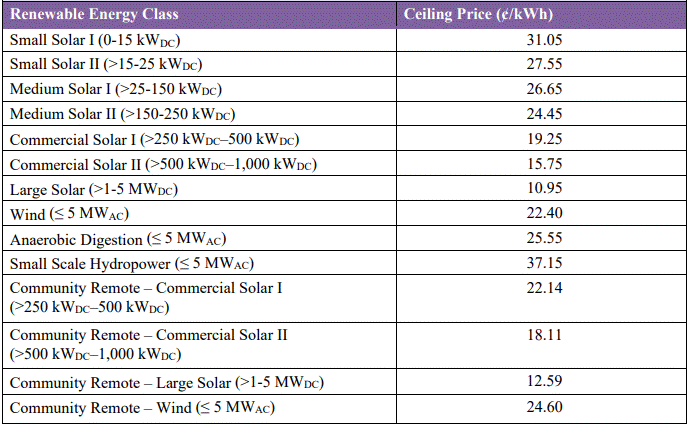
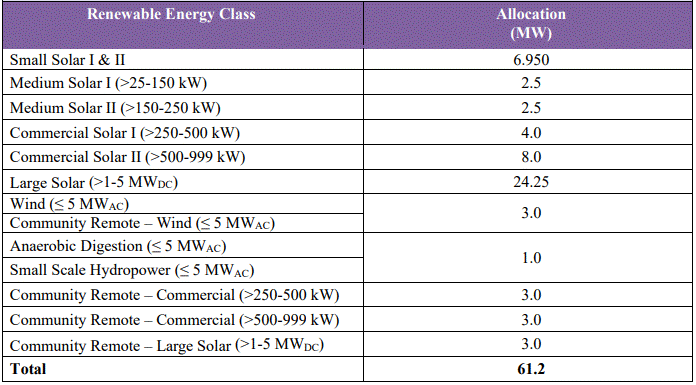
As discussed in Flash Update 92.1, unlike previous program years,
the proposed ceiling prices for the 2022 Program Year have generally increased
relative to the 2021 Program Year ceiling prices (with the exception of the
Large Solar class). As discussed in Digest 91, these increases are a product of
upward cost pressures resulting from the COVID-19 pandemic and other economic
factors which resulted in increased capital, materials, labor and
transportation costs relative to 2021. These cost pressures were offset
somewhat by forecasted declines in solar prices, which, for the Large Solar
class, was sufficient to reduce ceiling prices relative to 2021.
These cost pressures also contributed to a less-favorable
benefit-cost ratio in SEA’s updated Solar Carport Adder analysis. Specifically,
SEA found that, based on inflated capital costs, the calculated Carport adder
revenue requirement under current market conditions ranged between 8.2 and 12.2
cents/kWh. Due to this increased cost, SEA’s updated BCA found the net-benefits
of the program to be negative in most scenarios tested.
FERC Denies Green Development Request for
Rehearing regarding arguments against National Grid DAF charges
As discussed in Digest 88, on February 10, 2021, Green Development
filed a Complaint against the National Grid
affiliates Narragansett Electric Company (which owns distribution and
transmission assets in Rhode Island) and New England Power Company (which owns
and operates bulk power transmission systems and operates some of
Narragansett's transmission assets), arguing that National Grid passed on
unauthorized Direct Assignment Facility (DAF) charges to Green Development
solar projects. As discussed in Flash Update 91.4, on September 23, 2021, in
Docket EL21-47, FERC issued an Order, rejecting the majority of Green
Development's arguments. FERC agreed with Green Development that National Grid
had failed to comply with one requirement for DAF charges, specifically the
requirement that DAFs be "specified in a separate agreement among ISO-NE,
the Interconnection Customer, and the Transmission Customer, as applicable, and
the Transmission Owner whose transmission system is to be modified." FERC
found that New England Power "may not assess [DAF] charges to Narragansett
in association with the upgrades necessary for the Projects unless and until it
complies with this part of the definition."
The ISO-NE Tariff defines a DAF as follows:
Facilities or portions of
facilities that are constructed for the sole use/benefit of a particular
Transmission Customer [in this case, Narragansett] requesting service under the
[ISO-NE Tariff] or a Generator Owner requesting an interconnection. Direct
Assignment Facilities shall be specified in a separate agreement among the ISO,
Interconnection Customer and Transmission Customer, as applicable, and the
Transmission Owner whose transmission system is to be modified to include
and/or interconnect with the Direct Assignment Facilities, shall be subject to
applicable Commission requirements, and shall be paid for by the Customer in
accordance with the applicable agreement and the Tariff.
On October 25, Green Development filed a Request for Rehearing, arguing that Green
Development met ISO-NE’s criteria to prove that "Facilities or portions of
facilities that are constructed for the sole use/benefit of a particular
Transmission Customer requesting service under the [ISO New England Inc.
Transmission, Markets, and Services Tariff (“ISO-NE Tariff”)] or a Generator
Owner requesting an interconnection."
On November 26, FERC issued a Notice of Denial of Rehearing, announcing that
as FERC has not acted, the Request for Rehearing is deemed denied by operation
of law and stating that it will address the subject matter of the rehearing
request in a future Order.
Other Rhode Island News
of Note
- Newport approves CCA with Good
Energy to commence in 2022:
According to the Newport Daily News, Newport’s City Council has authorized
Good Energy LLC to develop a Community Choice Aggregation (CCA) plan, so
that the city can source energy for its xxx from a competitively-selected
supplier, ideally at lower rates and with a higher proportion of renewable
energy. Good Energy has created such plans for 41 communities, most of
which are in Massachusetts, totaling over 1 million residents receiving
energy under these bids. The program is expected to start sometime in
early 2022.
Maine
DEP suspends NECEC
permit, construction halted until Courts reach a determination
As discussed in Flash 90.4, on August 12, 2021, Melanie Loyzim,
Commissioner of the Maine Department of Environmental Protection (DEP), sent
a letter notifying Central Maine Power
(CMP) that she would exercise her discretional authority to initiate proceedings
to consider suspension of DEP’s May 2020 Order approving CMP’s applications
for State land use permits for its New England Clean Energy Connect (NECEC)
project. The NECEC project would be a 1,200 MW HVDC transmission line that
would run from Québec to Lewiston, Maine. Commissioner Loyzim’s letter was
issued after the Maine Superior Court Order in Black
v. Cutko vacated a one-mile tract lease granted to NECEC Transmission
(a subsidiary of CMP) for the NECEC project located in Johnson Mountain
Township and West Forks Plantation (discussed in Digest 91).
As discussed in Flash Update 91.7, on October 19, the DEP held its
first suspension hearing for the NECEC project. See Flash Update 92.4 for
coverage of the post-hearing briefs that followed the suspension hearing.
As discussed in Flash Update 92.2, on November 2, a ballot measure that would ban
construction of high impact transmission lines in the Upper Kennebec region,
require legislative approval for such projects outside of the region and 2/3
approval for projects using public lands, passed in a referendum. On November
3, Avangrid and NECEC LLC (a subsidiary of CMP) issued a press release announcing that it had
filed a lawsuit challenging the ballot initiative in Maine Superior Court, as
well as a motion for a preliminary injunction. As discussed in Flash Update
92.2, on November 5, 2021, Commissioner Loyzim scheduled a public hearing for
November 22, to consider whether “additional changes in circumstance” should
cause the agency to suspend its construction permit if the referendum result
becomes law. As discussed in Flash Update 92.4, On November 19, Governor Janet
Mills proclaimed and certified the results of
the referendum, earlier than expected and well within the 10-day time frame the
Maine Constitution allows her to do so. The legislation will go into effect 30
days following the Governor’s proclamation (barring a Court injunction as a
result of NECEC LLCs legal challenge of the referendum).
November 22 Hearing and November 23 Suspension
On November 22, the DEP held its second suspension hearing, this
time focusing on whether the referendum results constituted a change in
condition or circumstance requiring suspension of the May 2020 Order approving
CMP's land-use permits. Recordings of the hearing are available here: Part 1 and Part 2.
At the hearing, NECEC LLC and its supporters argued that the
referendum results did not constitute a change in circumstances that would
require suspension of the May 2020 Order because:
- The ballot measure will not go
into effect until December 19, 2021, and is the subject of a legal
challenge by Avangrid;
- CMP could still try to build on
alternative routes even if the ballot measure takes effect; and
- Construction had already been
voluntarily paused temporarily, following a request by Governor Mills, discussed
in Flash Update 92.4.
The Natural Resources Council of Maine (NRCM), West Forks (made up
of West Forks Plantation, the Town of Caratunk, Kennebec River Anglers, Maine
Guide Service, LLC, Hawks Nest Lodge, and nine individuals )and the Friends of
Boundary Mountains disputed the viability of alternative routes argued that the
referendum results should be presumed constitutional until proven otherwise and
argued that continued construction would create further environmental harm.
Stakeholders also disputed the definition of 'Upper Kennebec
Region.' The legislation attached to the ballot
initiative bans high impact transmission lines in the Upper Kennebec Region,
requires legislative approval for the construction of high-impact electric
transmission lines anywhere in Maine and requires approval of the legislature
(by a two-thirds vote) if the transmission line crosses public lands, defined
by Title 12, section 598-A. While the ballot
measure bans the construction of high impact transmission lines in the Upper
Kennebec Region, the region was not defined in law before the ballot
initiative. The ballot measure defines the Upper Kennebec Region as "the
approximately 43,300 acres of land located between the Town of Bingham and Wyman
Lake, north along the Old Canada Road, Route 201, to the Canadian border, and
eastward from the Town of Jackman to encompass Long Pond and westward to the
Canadian border, in Somerset County and Franklin County." However, this
definition does not provide an exact boundary of land included in the region.
The PUC and courts will eventually determine what is included in the Upper
Kennebec Region for the purposes of the ballot measure.
As announced in Special Flash 92.4.1, on November 23, Commissioner
Loyzim suspended the May 2020 Order due to the
referendum results, while deferring a decision on whether the Black v.
Cutko ruling also required suspension. In her decision, Commissioner
Loyzim determined that while the specific boundaries of the Upper Kennebec
Region are not yet clear, NECEC LLC has previously acknowledged in litigation
that the ballot measure ban would apply to the NECEC project. Loyzim also
reasoned that alternative routes presented by NECEC LLC would not likely be
viable. Loyzim concluded that "this point there is not a reasonable
likelihood of the Project being able to deliver power." The suspension
stopped construction immediately. The suspension is effective unless and until:
- A court issues a preliminary
injunction of the ballot measure and allows continued construction pending
the conclusion of CMP-NECEC's lawsuit;
- The court does not grant an
injunction, but rules in favor of CMP-NECEC in their legal challenge of
the referendum.
According to the Portland Press Herald, on November 29, the
Natural Resources Council of Maine, the Sierra Club, and the Appalachian
Mountain Club wrote a letter to the U.S Army Corps of Engineers and the U.S.
Department of Energy asking for the agencies to suspend or stay their permits
for the NECEC project.
PUC issues 2-stage RFP
for Transmission and Generation in Northern Maine; transmission bids due March
1, 2022 generation bids due May 1, 2022
As discussed in Flash 89.5, on June 29, 2021, Governor Janet Mills
(D) signed LD 1710 - An Act To Require Prompt and Effective Use of
the Renewable Energy Resources of Northern Maine into law
as Chapter 380. Among its initiatives, Act 380
requires the Public Utilities Commission (PUC) to issue two procurements:
- An RFP for the development and
construction of a transmission line to connect renewable energy resources
located in northern Maine with the ISO-NE electric grid; and
- A procurement of renewable
energy projects to connect and transmit power on the above-mentioned
transmission line.
These procurements are a very significant opportunity for the
development of renewable energy resources and present one of the best chances
for the development of large land-based wind projects in Northern Maine.
In Flash Update 91.4, we summarized the PUC's Notice of Inquiry (NOI) for the
procurement in Docket 2021-00223 and the comments filed
in response to the NOI. As announced in Special Flash Update 92.4.2, on
November 29, 2021, in Docket 2021-00369, the PUC issued its RFP. Transmission bids are due March 1, 2022,
generation bids are due May 1, 2022.
RFP Process
The RFP includes the following schedule:
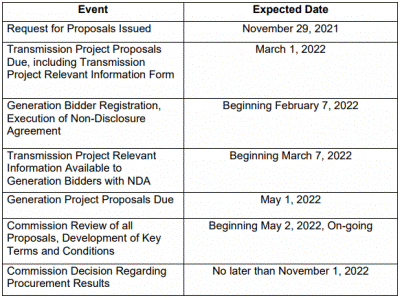
The RFP seeks proposals for both renewable energy generation
projects in Northern Maine (defined as Aroostook County and other areas in
Maine administered by the Northern Maine Independent System Administrator
(NMISA)) and the transmission line (or lines) that will carry power from the
generation projects to the ISO-NE system.
The RFP will proceed in two phases. In Phase 1, the PUC will
consider transmission project proposals. In Phase 2, the PUC will consider
generation project proposals. Generation bidders will have access (under a
Non-Disclosure Agreement) to Transmission Project Relevant Information (TPRI)
provided by the transmission project bidders. The PUC noted that it will work
to ensure that generation projects will have fair access to transmission
project information, and that the PUC has structured the RFP to achieve that
goal.
Transmission Project Requirements and Preferences
As required by Chapter 380, the PUC is requesting proposals for a
345-kV or greater capacity double circuit transmission line delivering power
from renewable energy resources in Northern Maine to ISO-NE. The RFP states
that the PUC prefers projects allowed under ISO-NE authority, processes, and
tariffs. Acceptable projects include the following:
- Reliability Transmission
Upgrade (RTU),
- Market Efficiency Transmission
Upgrade (METU),
- Public Policy Transmission
Upgrade (PPTU),
- Elective Transmission Upgrade
(ETU), and
- Other, e.g., State Voluntary
Agreements (SVA).
We provided an explanation of each of the above options in Flash
Update 91.4. We note that to date, no METU or PPTU has ever been identified in
ISO-NE, and that most comments responding to the NOI argued that an ETU approach
is the most likely transmission option.
The PUC has not yet released the essential terms that it will
expect to be included in an eventual Transmission Service Agreement (TSA)
between the state’s transmission project and transmission and distribution
(T&D) utilities, but will eventually release these terms on the RFP website.
The RFP outlines the minimum information that must be included in
transmission project proposals, including, among other requirements, project
design, approval processes, ratepayer impacts, and benefits provided towards
Maine's energy goals. Additionally, the RFP requests that proposals address the
topic of approval from the Maine Legislature following the results of the
November 2, referendum. As discussed in Flash Update 92.2, Maine's November 2,
2021 election included a ballot question asking Maine voters “Do
you want to ban the construction of high-impact electric transmission lines in
the Upper Kennebec Region and to require the Legislature to approve all other
such projects anywhere in Maine, both retroactively to 2020, and to require the
Legislature, retroactively to 2014, to approve by a two-thirds vote such
projects using public land?” The ballot initiative defines "high impact
electric transmission lines" as transmission lines 50 miles or more in
length for direct-current electricity or capable of operating at more than 345
kV, with the exception of generator interconnection transmission facilities or
lines determined by the PUC to deliver electric reliability. To clarify the
effect of the referendum, the ballot initiative legislation (accessible at the
above link) bans high impact transmission lines in the Upper Kennebec Region,
requires legislative approval for the construction of high-impact electric
transmission lines anywhere in Maine and requires approval of the legislature
(by a two-thirds vote) if the transmission line crosses public lands, defined
by Title 12, section 598-A. On November 2, Maine
voters passed the ballot initiative, and the legislation is set to become law
on December 19 (30 days after Gov. Mills certified the election results),
barring the issuance of a preliminary injunction requested by Avangrid, the
parent company to Central Maine Power and New England Clean Energy Connect LLC,
discussed in Flash Update 92.2 and further in this Flash Update.
The PUC noted that it would prefer transmission pricing to be
structured on a $/kW/month basis. Additionally, any variable pricing structure
(i.e., cost of service, indexed, non-fixed price) must include a cap for the
costs to be paid by Maine’s T&D utilities under the terms of the TSA.
Each transmission project proposal must include a security deposit
of $100,000, to be refunded if the project is not selected or replaced with the
"Project and Performance Security" if the project is selected. Each
transmission proposal must also include a completed Project Relevant Information Form, the content
of which will be made available to generation bidders according to the above
schedule.
Generation Project Requirements and Preferences
Qualifying generation projects must meet the following
requirements:
- Be physically located in Northern Maine;
- Qualify as a Class 1 or Class 1A resource
- Excluding biomass generators fueled by landfill gas or
by anaerobic digestion and waste-to-energy generators fueled by municipal
solid waste;
- Be an energy storage system (note: the RFP does not
appear to envision a storage-only bid but rather the possibility of
generation bids that could include both generation and storage); and
- Commence construction on or after September 30, 2022;
- However, this requirement will not apply if, after
considering all generation project proposals constructed after September
30, 2022, the PUC determines that there would be remaining capacity
available (we are not sure how to interpret this provision, as it
provides no ‘or else’ language).
Generation projects would sign PPAs with T&D utilities, and
the PPA may include one or any combination of energy, capacity, and RECs. The
PUC plans to post a standard form PPA on the RFP website. The PUC stated that it would
prefer PPA terms of 20 years. Proposals may be structured as physical or
financial transactions, and may have separate prices for energy, RECs and/or
capacity. The PUC noted that it would prefer energy-only proposals.
Among other requirements, generation project proposals must
indicate which transmission project(s) the generation project intends for
interconnection, including contingencies if the PUC does not select the desired
transmission project. The same generation project may submit multiple pricing
proposals dependent on the generation project's preferred transmission project.
All bids including an energy storage system must also submit a separate bid
without energy storage.
Evaluation Criteria
The RFP does not divide the evaluation criteria between generation
and transmission, nor attribute point values to specific criteria. Criteria
include the following:
- Costs of the project
- The PUC emphasized that their evaluation of cost will
"focus on the cost and benefits to Maine ratepayers rather than the
overall costs and benefits of the project," and that "all other
factors being equal," the PUC will look favorably on projects that
employ methods to prevent the full cost of projects from being borne by
Maine ratepayers.
- The value to Maine ratepayers, including the following,
listed verbatim:
- Projected market value of energy, capacity, and/or
RECs;
- Locational value and effects related to delivery of
products;
- Amount and nature of transmission capacity, including
“firmness”; and
- Northern Maine ratepayer benefits;
- Economic benefits to Northern Maine;
- As required by Chapter 380, the PUC must make
"every effort" to include the selection of at least one contract
for a biomass generator fueled by wood or wood waste;
- Project viability and timely development;
- Technical and financial qualifications of the bidder
and related developers;
- Land use issues, including use of existing corridors
and rights-of-way;
We
note that Chapter 380 requires that the PUC show preference to proposals which
favor the construction of transmission line(s) along existing utility
rights-of-way and other existing transmission corridors.
- "Other factors that are relevant to the objectives
and criteria of the Act"; and
- Chapter 380 includes that the PUC should evaluate
proposals based on their contribution towards Maine renewable energy
goals under the RPS, Section 3210.
Next Steps
The PUC will continue to upload forms and documents to the RFP Website.
CMP and MREA/CCSA file briefs on PUC
jurisdiction related to cluster studies; reply comment period extended amidst
ongoing settlement negotiations
On November 17, 2021, in Case 2021-00270, in which the Coalition for
Community Solar Access (CCSA) and Maine Renewable Energy Association (MREA) are
requesting transparency and efficiency improvements to Central Maine Power’s
(CMP’s) cluster study process (last discussion in Flash Update 92.1), CCSA and
MREA filed a brief on jurisdictional questions posed by the
Public Utility Commission (PUC). The following day, on November 18, 2021, CMP
filed its brief on the same jurisdictional
questions. Generally, CCSA & MREA argued that the PUC has broad
jurisdiction with regard to transmission cluster study investigation and
prescribing remedies for cluster study timing, group formation, and the
interconnection of generators to the distribution system, while CMP argued that
PUC jurisdiction is limited to cluster study cost allocation, allocation of
network upgrade costs, and the study attrition process.
Reply Briefs were scheduled to be due on November 24, 2021.
However, on November 23, the PUC issued a Procedural Order granting CMP's Request for an Extension to file Reply
Briefs until December 22, 2021. CMP’s Request for Extension noted that CMP,
CCSA and MREA are engaged in settlement discussions on the issue raised in both
the cluster study instant docket and Case 2021-0035, the investigation of CMP
interconnection practices last discussed in Flash Update 92.3. CMP's Request
for an Extension noted that though there have been multiple requests for
extension in both dockets, CMP believes that "a settlement is
feasible" and would be "in the interest of all stakeholders."
Agricultural Solar
Stakeholder Group holds final meeting on December 16, releases draft report
overviewing agricultural siting policies and recommending dual-use pilot
program and incentives to preserve farmland
On November 12, 2021, the Agricultural Solar Stakeholder Group
released its Draft Report on balancing farmland
protection and renewable energy production in Maine. The initial report, once
finalized, will be presented to the Department of Agriculture, Conservation and
Forestry (DACF) and the Governor's Energy Office (GEO). The next and final
meeting of the Agricultural Solar Stakeholder Group is scheduled for December
16, 2021, from 9:00 am - 12:00 pm and interested stakeholders can
register to attend the virtual meeting here. We provide a summary of the report
below.
The Draft Report observed that the Working Group was formed by
DACF and GEO in response to L.D. 820 – Resolve, To Convene a Working
Group To Develop Plans To Protect Maine’s Agricultural Lands When Siting Solar
Arrays to recommend ways to protect agricultural land while also
fostering the growth of solar in Maine consistent with the legislatively
mandated greenhouse gas reductions and the "Maine Won’t Wait" climate
action plan. The Draft Report gives an overview of both the photovoltaic solar programs
and the economic contributions of the agricultural industry in the state.
Other States: The Draft Report reviews the agricultural
solar siting policies in three other states, Massachusetts, New Jersey and
Vermont, for lessons learned. The group found that the Massachusetts solar
program has made changes to require solar on greenfields to be dual-use and
document agricultural output, and while some aspects could be transferable to
Maine, the two states differ significantly in ways that would affect solar
siting on agricultural land. New Jersey faces similar agricultural land loss,
and the report notes that New Jersey has a dual-use pilot program for 200 MW of
solar with stipulations that the solar must be sited on "unprotected"
(i.e., not prime) farmland in addition to other safeguards. The Vermont Public
Utility Commission's (PUC's) Certificate of Public Good (CPG) process allows
Vermont’s Agency of Food and Markets to weigh in on projects on farmland, and
there are policy incentives to discourage siting on greenfields and encourage
siting on parking lots, brownfields, and landfills. The Draft Report also notes
that farms in Vermont can install solar arrays up to 500 kW and retain “current
use” taxation status if at least 50% of the solar project output is consumed on
the farm.
Stakeholder Perspectives: The Maine Audubon Society
presented data from the GIS Maine Renewable Energy Siting Tool showing
that of 180 projects that triggered Department of Environmental Protection
(DEP) review, 43% are proposed to be on high-value habitat, 49% are proposed to
be on large forest blocks, 58% are on high-value agricultural land, and 89% are
on high-value agricultural blocks (the distinction between "land” and
“blocks” is that blocks are contiguous areas of agricultural or forest land).
Only 9% were proposed to be located on brownfields or landfills, which often
lack access to transmission infrastructure.
The Maine Municipal Association (MMA) raised concerns that
sheltering agricultural land with solar installed on it in current use tax
status harms municipal revenue, and argued that "farmland developed for
solar should be removed from current use tax programs." Additionally, MMA
noted that volunteer planning boards are not always equipped to grapple with
solar development in their towns.
Nexamp commented on the uncertainty of interconnection costs for
solar projects, and outlined a number of policies that Nexamp supports, such as
pollinator scorecards and mitigation fees for the lost value of farmland.
BlueWave Solar argued for a voluntary dual-use market for
"agrivoltaics" and pointed to two projects under development by
BlueWave in Maine that integrate agriculture and sheep grazing with the solar
arrays as examples that solar siting can coexist with farming.
Clemedow Farm's presentation focused on the farm's process of
attempting to install solar on 45 of 1000 acres of its farmland, and noted that
local permitting has been challenging and that most farmers do not have the
resources to research the legal and tax implications of installing solar on
their land.
The Department of Environmental Protection (DEP) noted that
projects over 20 acres trigger Site Law review, and that DEP is
conducting a rulemaking to allow projects between 20-50 acres to obtain Permit
by Rule instead of the traditional permitting process. Projects greater than
one acre trigger stormwater management review. DEP also noted that it is
developing pilot projects to examine grazing as a form of vegetation management
for solar arrays. Recently enacted P.L. 2021 ch. 151 will require a
decommissioning plan and decommissioning financial assurance from projects over
three acres, as well as requiring the removal of inground solar components up
to 48 inches deep.
The Maine Revenue Services Property Tax Division presented to the
Stakeholder group that land is taxed at its highest and best use, which is generally
not farming. However, the Farmland Tax Program can, if certain criteria are
met, allow agricultural land to be taxed based on "current use"
rather than market value. Generally, conversion to energy generation would take
land out of the Farmland Tax Program, however, there is a legislative exception
for solar projects under "5 MW which provides net energy billing credits
solely to the farm." In these instances, the solar equipment is
tax-exempt, the state reimburses the town for 50% of the lost revenue on the
solar equipment (but not the land value). Dual-use projects not enrolled in the
net energy billing (NEB) program would be removed from current use, but
"it is unclear at this time" whether a project that offsets load on a
farm through the NEB program but also exports power to the grid would be
covered by the Farmland Tax Program.
The Working Group has tabled consideration of a siting scorecard
and an in-lieu fee (where solar development on agricultural land would trigger
some manner of payment).
Recommendations: The Working Group's Draft
Report would adopt the following recommendations for solar siting on
agricultural land:
- Creation of a centralized source of information on
solar projects run by DACF using permitting data from DEP;
- Creation of a pilot program for dual-use projects that
would potentially include financial incentives or permit waivers for
projects enrolled in the pilot program:
- Such a program should consider how to treat dual-use
land for tax purposes, and should treat solar that serves load on the
farm where it is located as agricultural equipment;
- Dual-use and/or co-location standards should be
considered as part of DEP's permit by rule process;
- Development of capacity hosting maps by the electric
distribution companies (EDCs) to help developers optimally site solar
projects;
- Provision of more technical assistance and financial
support to municipalities "to welcome solar development"; and
- Inclusion of agricultural siting characteristics in
state programs to incentivize future solar deployment, such as dual-use
adders or bid preferences for solar projects with minimal agricultural or
natural resource impacts.
The December 16, 2021 meeting mentioned above is the last meeting
of the Working Group, after which the Working Group will present a finalized
report to the DACF and GEO.
76.5 MW Farmington solar
project in Maine has entered service, will supply power to five New England
colleges
On October 27, 2021, the 76.5 MW Farmington Solar project went
online. As first discussed in Digest 67, the project was initially a 49.36 MW
project, but increased in size following the signing of a 20-year PPA with the
New England College Renewable Partnership, made up of Bowdoin College,
Hampshire College, Smith College, Amherst College and Williams College. The
colleges' PPAs will help them achieve each of their climate action goals while
also increasing the predictability of their electricity costs. A subsidiary of
NextEra Energy Resources developed the project and Competitive Energy Services
acted as an adviser to the colleges.
FERC issues NOI to prepare EIS for the four
Kennebec River dams for effects on endangered Atlantic salmon
On November 20, 2021, FERC issued a Notice
of Intent (NOI) to prepare a draft and final Environmental
Impact Statement (EIS) to evaluate the effects of relicensing the Shawmut
hydroelectric project (FERC Project No. 2322) and amending the licenses of the
Hydro-Kennebec, Lockwood, and Weston hydroelectric projects. FERC previously issued
a Draft
Environmental Assessment (DEA) for relicensing the Shawmut
project in July, which received numerous comments compelling FERC to complete a
more comprehensive EIS to fully evaluate the impacts of the four projects on
the migratory fish populations of the Kennebec River. Brookfield Renewables
owns all four of the projects, which are located on the Kennebec River and have
faced opposition surrounding their impact on Atlantic salmon populations in the
river (as recently discussed in Flash Update 92.1). The NOI noted that FERC
anticipates the relicensing-related actions to require a Water Quality
Certification by the Maine Department of Environmental Protection (DEP), per
the Clean Water Act Section 401, as well as an Endangered Species Act Section 7
Consultation by the National Marine Fisheries Service. As discussed in Flash
Update 92.2, Brookfield Renewables submitted an application to the Maine DEP seeking a
Water Quality Certification for the Shawmut Dam on October 15.
FERC is accepting public comment regarding how to scope the issues
covered in the EIS until December 30, 2021, and details on how to
comment can be found in the notice.
The EIS will address previously raised concerns from the earlier Shawmut
Project scoping process and DEA, so comments filed during those windows do not
need to be resubmitted. FERC intends to issue the draft EIS in August 2022, and
the final EIS by February 2023, though notes the possibility of schedule
changes.
Efficiency Maine Trust
reports that it issued 12 awards for installation of 58 Level 2 charging ports
in EV charging pilot
As discussed in Digest 83, on August 28, 2019, in Case 2019-00217, as required by statute, the
Maine Public Utilities Commission (PUC) issued a Request for Proposals (RFP)
for pilot programs to support beneficial electrification in the transmission
sector. On February 25, 2020, the PUC issued an Order approving a proposal by Central Maine Power Company
(CMP), to establish a "Make Ready Pilot Program" that will distribute
subsidies of up to $4,000 each to support the construction of sixty (60) Level
2 chargers (Level 2 chargers are 240v whereas Level 1 charges are 120v).
On November 17, the Efficiency Maine Trust (the Trust) released an interim update on the implementation of
the proposed pilot program. In all, the Trust has held five rounds of RFPs for
Level 2 chargers. See below for the list of projects awarded under Round three
and round four:
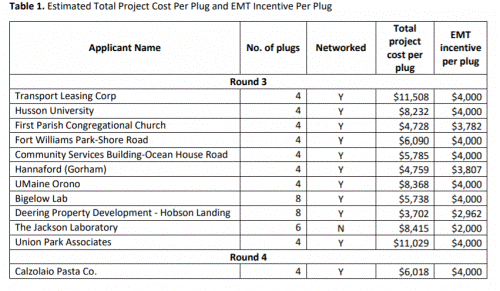
In all, the Trust issued twelve awards totaling 58 charging ports,
with the average total project cost per port landing at $7,031. Eligible
locations included qualified multi-unit dwellings, workplaces, or locations
open to the public (including government properties). EMT offered incentive
amounts of up to $2,000 per port for non-networked chargers and $4,000 per port
for networked chargers. Three of these installations have been completed and
reimbursed to date, with the remaining Round 3 installations expected by
January 6, 2022, and the Round 4 installation expected by the spring of 2022.
Proposals for Round 5 are due on January 20, 2022, with awards expected in
early February.
The Trust found that the electric vehicle and EV charger industry
is undergoing rapid changes, with a greater adoption of networked chargers and
a transition of charging equipment from the charger to electric vehicles
themselves. They also noted that prior guidance and conventional wisdom suggested
EVs would need to be charged at public chargers at similar rates as internal
combustion vehicles (ICEVs), but it is becoming more clear that EV drivers
prefer to charge overnight at home (generally, using Level 1 and 2 charging
stations), and that Level 2 public charging infrastructure may not be as highly
utilized as once assumed. Off-peak charging, the Trust added, should be
encouraged through innovative rate to reduce strain on the electric grid.
Finally, the Trust highlighted how the results of this pilot program can inform
future EV charging incentive design. They suggested that $5,000 may be a more
appropriate incentive amount for networked chargers, due to the $7,031 per port
cost that they determined, while $2,000 or potentially less should be sufficient
for non-networked chargers.
The Trust is currently in the process of creating a series of
“guidebooks” for potential EV charging hosts, the first of which was released
in September: “How to Select and Install a Home Electric Vehicle
Charger”. The next guidebook, “How to Charge Your EV at Home and
Away,” is scheduled for an early 2022 release.
ReVision submits
comments arguing proposed Versant O&M cost methodology overallocates costs
to interconnecting customers; PUC delays implementation of O&M costs until
February 2022
On November 18, 2021, in Case 2021-00351, in which Versant Power
(Versant) has proposed a new Section 42 of its terms and conditions (T&Cs),
ReVision Energy (ReVision) filed comments taking exceptions to the
proposed cost allocation methodology. As last discussed in Flash Update 92.2,
Section 42 governs the monthly operations and maintenance (O&M) costs of
non-FERC jurisdictional interconnection facilities and distribution upgrades
installed under Chapter 324.
ReVision argued that:
- Stakeholders should have access
to Versant's FERC Form 1 (which Versant subsequently filed in the Docket);
- The property tax costs as
proposed by Versant do not account for the depreciation of assets and
should decrease over time rather than using a fixed multiplier. ReVision
further contended that Versant’s proposed methodology does not distinguish
interconnection facilities from distribution upgrades, which would
potentially expose projected developers to more than the “incremental”
costs stipulated in Chapter 324 § 3(B);
- The reduced O&M costs to
Versant from upgrades to the distribution system should offset part of the
O&M costs paid by interconnecting customers. ReVision uses the example
of replacing in-line fuses with reclosers that can save Versant money and
improve reliability, and therefore those reduced costs should be taken
into consideration when determining an interconnecting customer's O&M
costs.
On November 23, 2021, the Maine Public Utility Commission (PUC)
issued a Suspension Order that suspended the
proposed T&Cs until February 26, 2022 to give the PUC
adequate time to review the proposal. As discussed in Special Flash Update
92.3.1, On November 32, 2021, the PUC held a technical conference on the
O&M costs, (transcript of the technical conference can be viewed here) as well as a Notice of Filing, request
for comment and opportunity to intervene. Post-technical conference briefs are
expected to be the next step in this Docket.
Versant submits two Joint
Offers of Settlement between itself and MPUC to resolve issues raised in
response to Versant's Order 864 filing, 2020 annual transmission charges update

On November 19, 2021, Versant Power filed a Joint Offer of Settlement between itself
and the Maine Public Utilities Commission (PUC) regarding issues raised to FERC
by the PUC about Versant's annual transmission charges update for Bangor Hydro
District filed on June 15, 2020 (the Annual 2020 Update) in Docket ER15-1434
under Section 21-EM of the ISO-NE Transmission, Markets, and Services Tariff.
Through Schedule 21-VP of the ISO-NE Open Access Transmission Tariff (OATT),
Versant provides service over non-Pool transmission facilities (non-PTF). On
September 14, 2020, MPUC communicated to Versant certain disputes about its
2020 Annual Update, which the two parties were able to resolve. If the Joint
Offer of Settlement is approved by FERC, it will resolve all issues raised by
the PUC. Interested parties must comment on the Offer of Settlement by December
9, 2021, and Reply Comments must be filed by December 19, 2021.
On November 22, 2021, Versant Power filed a Joint Offer of Settlement between itself
and the PUC regarding issues raised by the PUC regarding Versant's compliance
with FERC Order 864. FERC issued Order 864, which was issued in November 2019
required that all public utility transmission providers with formula rates
under an OATT "revise those transmission formula rates to account for
changes caused by the Tax Cuts and Jobs Act of 2017 (TCJA)." The TCJA,
which President Trump signed in December 2017, among other things, reduced
federal corporate income tax rate from 35% to 21% effective January 1, 2018.
Versant submitted a compliance filing with Order 864 on June 23, 2020 which
spurred several back and forth requests for information and deficiency letters
between itself and the PUC. Ultimately, in settlement discussions, Versant and
PUC were able to resolve their differences, resulting in a stipulation included
in the Joint Offer of Settlement. If the Joint Offer of Settlement is approved
by FERC, it will resolve all issues raised by the PUC. Interested parties must
comment on the Offer of Settlement by December 13, 2021 and
Reply Comments must be filed by December 22, 2021.
CMP files Petition for
advisory ruling on definition of "aggregated generation" when
screening for Level 2 interconnections, argues definition should include all
generation with an executed interconnection agreement
On November 19, 2021, in Docket Case 21-00372, Central Maine Power (CMP) filed
a Request for Advisory Ruling seeking
guidance from the Public Utility Commission (PUC) on how electric distribution
companies (EDCs) should treat Level 2 Interconnection applications.
Specifically, CMP requested clarification on how to implement the PUC's ruling
in Case 2021-00084 (the Maynard Ruling),
(summarized in Digest 89). In the Maynard Ruling the PUC found, in CMP's
wording, that "utilities should disregarding other proposed
interconnections when performing screening for proposed Level 2
interconnections" (Level 2 projects have a capacity of between 25 kWAC and
2 MWAC and receive faster interconnection processing times, Level 4 projects
have a capacity greater than 10 MWAC and a longer interconnection process).
CMP argued that the Maynard Ruling is "untenable" for
the EDCs. CMP's petition maintained that to operate the electric system safely
and reliably, CMP must consider generation that may come online when studying
the interconnection of generation facilities. In particular, CMP noted that
facilities with a signed interconnection agreement have a legal right to reach
commercial operation. But under the ruling in Case 2021-00084 as CMP interprets
it, the EDC might encounter a situation where, if level 2 projects seek to
interconnect ahead of Level 4 projects after the Level 4 project has a signed
interconnection agreement, upgrades would be required to accommodate projects
without a way to allocate costs to the interconnecting customer.
CMP argued that "aggregate generation" used in CMP
interconnection screening and planning should include all generation with an
executed interconnection agreement. CMP requested that the PUC, in an advisory
ruling, answer the following questions (listed verbatim):
- How would the T&D utility
assess the impact of Level 2 generation interconnected after a Level 4
study and interconnection agreement are complete?
- How would a T&D utility
proceed when it receives a Level 2 application while it is in the midst of
a Level 4 Study? Will the Level 4 project be responsible for upgrades made
necessary by the Level 2 project?
- Who would be financially
responsible for any required study?
- Who would be financially
responsible for any upgrades required from any such study?
- Who would be financially
responsible for the restudy of queued projects to include new upgrades?
- Who would be financially
responsible for those upgrades?
No other stakeholders have commented on the case so far, nor has
the PUC issues a procedural schedule.
PUC issues advisory
ruling denying Renergetica request for interconnection cost-sharing exemption
for level 4 project
On November 18, 2021, in Case 2021-00297, the Public Utility Commission
(PUC) issued an Advisory Ruling denying Renergetica’s
request for interconnection cost-sharing exemption for its Level 4 Houlton Road
Solar Farm (HRSF) project. Renergetica had requested that a Level 4 project be
defined as "aggregate generation" or in the alternative, exempted
from further cost allocation with level 2 projects (as last discussed in Flash
Update 91.5).
Renergetica, had executed an interconnection agreement with
Versant Power (Versant) and paid the interconnection deposit prior to the
Maynard Ruling, but after the Maynard Ruling a Level 2 project interconnected
ahead of the HRSF project on the same circuit as the HRSF project due to the
Chapter 324 rules. (In the Maynard Ruling, the PUC ruled that the definition of
"aggregate generation," for the purposes of performing a Level 2
screen, "does not include proposed generation other than that of the
proposing generator" and therefore the HRSF project was not factored into
the interconnection screening of the Level 2 project.) The Level 2 project's
interconnection caused the HRSF project's interconnection costs to rise from
$267,000 to an estimated $1.2 to $1.7 million, and delayed the interconnection
timeline. After negotiations with Versant, Renergetica reduced its project by
250 kWAC to a total of 1.72 MWAC so that
Renergetica would only be responsible for the initial interconnection upgrade
costs of $267,000. However, Versant could not assure Renergetica that another
Level 2 project would not enter into an interconnection agreement with Versant,
leading to a similar situation. Therefore, Renergetica sought an Advisory
Ruling that its project would either be treated as aggregate generation or
receive an exception from the cost-sharing requirements for Level 4 projects,
arguing that it cannot proceed with the project under the current uncertainty
over development timelines and interconnection costs. (Level 2 projects have a
capacity of between 25 kWAC and 2 MWAC and
receive faster interconnection processing times, Level 4 projects have a
capacity greater than 10 MWAC and a longer interconnection
process.)
The PUC denied Renergetica's request to be shielded from further
cost allocation, upholding its decision in Case 2021-00084 (Maynard’s Advisory
Ruling). The PUC found that there was no justification for exempting the HRSF
project from the same cost-sharing requirements as other Level 4 projects.
However, in doing so, the PUC acknowledged that the issues raised by
Renergetica are important and that they should be addressed in a rulemaking,
likely referring to Docket 2021-00167 where the PUC is reviewing the screening
of Level 2 projects for interconnection.
Maine DOT releases
Searsport offshore wind port feasibility study
On November 23, 2021, Governor Janet Mills announced her administration’s plan to
evaluate multiple port development options and offshore wind uses at the Port
of Searsport, the Port of Portland, the Port of Eastport, as well as others.
This announcement follows the Maine Department of Transportation’s (MaineDOT)
November 18 presentation of the Feasibility Study and Concept Design Report to
the Governor’s office. The study was produced in response to Governor Mills’
March 2020 request for the MaineDOT to study how the Port of Searsport (one of
Maine's largest seaports) could contribute to offshore wind growth in Maine, as
discussed in Flash Update 80.3.
The study, prepared for MaineDOT by infrastructure advisory firm
Moffatt & Nichol, analyzed the physical and technical characteristics of various
sites in the Port of Searsport and found that Mack Point and part of Sears
Island could be considered for offshore wind hub locations. Sprague Put Parcel
and the GAC Chemical site were also considered initially, though both sites
were removed from consideration in the study due to dredging and related cost
criteria. The study recommends that Sears Island be further studied for
possible phased development, so that impacts and alternatives can be properly
evaluated, as would be required by federal and state permitting. A broader
study on offshore wind and ports in Maine that looks at Ports of Portland and
Eastport is still underway, and is anticipated to be completed in a few months.
According to the Governor’s announcement, New England Aqua Ventus’ demonstration
project, slated for deployment in 2024, is expected to use the ports of
Eastport and Searsport for assembly and transportation.
Nexamp requests that PUC
allow access to customer records for NEB project sponsors
On November 22, 2021, Nexamp filed a Request for Waiver or Clarification with
the Maine Public Utilities Commission (PUC) in Docket 2021-00375. Specifically, Nexamp
requested a waiver of Chapter 815, Section 4 (Consumer
Protection Standards for Electric and Gas Transmission and Distribution
Utilities) stating that project sponsors of Net Energy Billing (NEB) projects
can request information from utilities for customers who have given affirmative
authorization. Alternatively, Nexamp suggested that the PUC could clarify that
a prior waiver granted to Central Maine Power (CMP)
in Docket 2020-00180, which allowed projects
access to commercial and industrial customer information, applies to project
sponsors who serve non-commercial customers. Nexamp stated that it needs the
customer information "to ensure that customer subscriptions are
appropriately sized to a customer’s historical usage, and that subscription
bills (bills from Nexamp to customers for subscription charges) accurately
reflect the interaction between customers’ NEB kilowatt-hour credits and their
electric charges."
PUC issues procedural
order denying EV rate design waivers to small utilities; VBLPD and EMEC respond
to order by updating existing rate schedules to include EV charging
As discussed in Flash Update 92.4, on September 30, 2021, in No. 2021-00198, the PUC issued a Procedural Order requiring Maine’s
transmission and distribution (T&D) utilities to file by November 1, 2021
proposed rate schedules for “nonresidential electric vehicle applications,
including, but not limited to, those for light duty vehicles, medium duty
vehicles, heavy duty vehicles and transit and other fleet vehicles.”
On November 1, 2021, Versant Power and Central Maine Power Company
(CMP) filed rate schedules. Several smaller utilities, including consumer-owned
utilities (COUs), made comments and requested waivers from submitting the rate
schedules, citing various reasons why they shouldn’t be required to file rate
schedules mandated by L.D.347, An Act To Facilitate Maine's Climate Goals by
Encouraging Use of Electric Vehicles (Chapter 402, enacted by Legislature in
2021 session).
On November 17, 2021, the PUC issued a Procedural Order, noting that chapter 402 does
not grant the PUC the authority to issue waivers. The Order notified the COUs
that they will be out of compliance with Chapter 402 but announced that the PUC
will review and consider proposed rate schedules received by December 10, 2021.
On November 19, 2021, the Eastern Maine Electric Cooperative (EMEC) and
the Van Buren Light & Power District filed
responses to the procedural order. EMEC altered their Residential Rate (Rate R)
to include availability for electric vehicle charging, energy storage, and heat
pumps, without altering the existing rate structure. Similarly Van Buren proposed
the application of its existing delivery rate to EV charging, reiterating its
stance that small utilities should not be required to dedicate limited
resources to designing all new rates that would see limited adoption in their
service territories.
Efficiency Maine Trust
submits petition for approval of Triennial Plan; Projects three-year energy
cost savings of over $1.57 billion from heat pump, demand management, and
electric vehicle infrastructure measures
As discussed in Flash Update 90.4, on June 9, 2021, the Efficiency
Maine Trust (The Trust) submitted its draft Triennial Plan V (“the Plan”)
(which spans fiscal years 2023, 2024, and 2025 from July 1 to June 30).
Initially, the development of the Plan was not highly pertinent to renewable
energy markets. However, with the addition of energy storage, heat pump and
electric vehicle incentives and other programs to the Trust’s slate of
programs, the development of the plan is now a material demand driver for new
renewable resources in Maine (and region-wide).
On November 29, the Trust filed a Request for Approval of the Triennial Plan with
the Public Utilities Commission (PUC) in Docket 2021-00380. The Trust calculated that
the measures installed under this plan over the next three years would lead to
energy cost savings exceeding $1.57 billion, $783 million of which would be
saved through avoided electricity costs (these savings estimates come with the
addendum that $25 million of American Rescue Plan Act funds allocated to
efficiency measures were not included in the benefits calculation due to a lack
of specified end uses). The final version of the Triennial Plan has a
total budget of $302 million over a three-year period. The Trust’s final
submission to the PUC for approval included a Program Roll-Up, which breaks down planned
expenditures per measure throughout the course of the plan.
In Flash Updates 90.4 and 90.6, we outlined some of the plan’s
most renewable energy-relevant provisions, focusing on initiatives dealing with
Clean Heating & Cooling, Electric Vehicles, and Demand Response (for which
battery storage systems are eligible), and discussed the appendices for these
initiatives that used testimony from various individuals within the organization
to provide more background and considerations that inform these initiatives.
The final versions of these appendices appear to be unchanged from the draft
versions that were released in August:
- Heat Pump Analysis and Considerations
- Demand Management Program (DMP) Analysis and
Considerations
- Electric Vehicle Initiatives Targets and Priorities
for Future Funding Sources
For more in-depth coverage on the provisions and incentives
contained in this plan, see our coverage in Flash Updates 90.4 and 90.6.
Versant files executed
agreement for 40 MW Goose Cove from Tranche 2 procurement
As discussed in Digest 87, on January 15, 2021, in Case 2021-00004, the Public Utilities
Commission (PUC) issued an Order (the “January Order”) announcing
the issuance of a Tranche 2 Request for Proposals (RFP)
seeking energy and/or RECs from Class IA eligible generation units. As
discussed in Digest 90, on June 29, the PUC issued an Order (the “June Order”) approving term
sheets for the Tranche 2 RFP (individual project term sheets can be found here). The June Order instructed Commission
Staff to work with Central Maine Power Company (CMP), Versant Power and the
approved developers to develop final contracts.
As discussed in Flash Update 92.1, on October 26, the PUC issued
an Order to approve final contracts, and
contract reports for Walden Renewables' 40 MWAC Goose Cove
Solar project located in Trenton, Maine. The project will receive $28.50/MWh in
an energy-only contract in its first year of operations, escalating by 2.5% in
each subsequent year. On November 24, Versant Power filed its Executed Agreement with the project.
Versant to restudy
steady-state analysis for Bangor Hydro District cluster study due to more than
20 MW attrition in the group, study on track for completion in January 2022
On November 29, 2021, in Case 2020-00014 (the proceeding tracking
ongoing cluster studies), Versant Power (Versant), filed an update on Cluster Study 3. The update notes
that the initial steady-state analysis did not demonstrate any needed upgrades.
However, because more than 20 MW of capacity have dropped out of the study,
ISO-NE rules require that the cluster be restudied to ensure that there will
still be no adverse impacts on the bulk power system.
Versant expects to complete the steady-state reanalysis alongside
the dynamic study, with the overall Cluster Study 3 expected to be complete by
"mid-January." After study completion, Versant will request review
and approval of the applicable proposed plan applications for the impacted
projects from the NEPOOL Reliability Committee. Versant attributed the MW
attrition to both the reduction in project size to qualify for the Net Energy
Billing (NEB) program that caps eligible project size at 2 MW, and projects
reducing their size to mitigate interconnection upgrade costs.
NEB Good Cause Exemption and Discrete Facility
Advisory Ruling trackers updated
SEA’s tracker of good-cause exemption requests to qualify for net
energy billing under Chapter 390 can be found here. The tracker tracks exemption petitions,
scheduled conferences and related PUC decisions. As discussed in Flash Update
89.6, on July 1, 2021, the Legislature enacted LD 936 - An Act To Amend State Laws Relating to Net
Energy Billing and the Procurement of Distributed Generation as Chapter 390 which, among other actions,
provides that any project from 2 MW to 5 MW would be “safe harbored” for
eligibility under the current net energy billing (NEB) program if the project
meets certain requirements and deadlines. As discussed in Flash 90.2, on July
21, 2021, the Public Utilities Commission (PUC), in response to inquiries about
how the legislation will be interpreted and how requests for relief will be
handled, issued a Notice to provide guidance. The PUC
advised that entities which do not meet every statutory requirement to
participate in net energy billing should file a good cause exemption petition
and cite external delays outside of their control.
SEA's tracker of requests for advisory rulings that projects qualify
as discrete facilities can be found here. Chapter 312 (the distributed generation
(DG) procurement rule) and Chapter 313 (the net energy billing (NEB)
rule) define discrete electric facilities as systems that "cannot be
collocated or in geographic proximity to either (1) another eligible facility
or (2) a distributed generation resource as defined in Chapter[s] 312 and 313
of the Commission's rules." SEA’s tracker includes all previous requests
that fall under the purview of the most recent update to the safe harbor. The
tracker will also track requests for advisory ruling and the corresponding PUC
orders.
Other Maine News of Note
- Belgrade extends development
moratorium, blocking solar and wind farms for another 180 days: According to the Morning Sentinel, residents at a
Belgrade Town Meeting voted to extend the Town’s development moratorium by
180 days. The moratorium prevents applications for various developments
from being accepted, including for solar and wind farms. Before opening
for such applications, the board is looking to implement decommissioning
plan and visual impact assessment requirements for solar and wind farms,
with the goal of supporting utility scale solar development in a way that
minimizes negative impact to the “scenic, cultural and natural resource
character of the town.” Belgrade’s annual Town Meeting will be held in
March, where elements of the moratorium likely to be lifted. Amendments to
the solar and wind provisions, however, will likely take longer to address
because the Planning Board only started work on them recently.
- Mechanic Falls institutes
180-day moratorium on solar projects:
According to the Sun Journal, the Mechanic Falls Town Council voted for a
180-day moratorium on solar power facility development, citing that more
time is needed for legal review of the ordinances currently in
development. The moratorium comes after the approvals of a 14,031 panel
NextGrid Renewable Energy project and a 9,288 panel New England Solar
Garden project that are planned for the town. Some planning board members
said that updated ordinances are needed to protect the Town both
financially and aesthetically.
PUC rejects utility energy efficiency plans, ordering transition
to "market-based" energy efficiency
On November 11, in Docket DE 20-092, the last day of outgoing
Chairwoman Dianne Martin, the Public Utilities Commission (Commission) issued
an Order, denying the petition of New Hampshire’s
gas and electric investor-owned utilities (the Joint Utilities) for approval of
their 2021-2023 Statewide Energy Efficiency Plan (Plan),
which was originally submitted on September 1, 2020. The Joint Utilities had
been awaiting a ruling on their Plan since a December 29, 2020 Order in which the Commission approved a
“Short-Term” extension of 2020 energy efficiency programs and the charges that
funded them. The Commission ruled on the 2018-2020 energy efficiency plan on
January 2, 2018, or nearly a year earlier in the three-year planning cycle than
the Order discussed in this article. In its Order, the Commission rejected the
Joint Utilities’ filed plan, instead ordering them to submit a new plan based
in system benefit charges (SBCs) mandated by the Commission. The Commission
further ordered the charges that fund the energy efficiency programs to return
to their 2017 levels by 2023. As a result, incentives for activities such as
demand response (including storage) and space heating electrification are likely
to decrease or possibly be eliminated.
Energy Efficiency Plan Description: The
total, 2021-2023 gas and electric budget of the filed Plan was $393 million, up
from a total of $176 million for the 2018-2020 period. While electric SBCs
varied by utility, according to the Commission’s analysis, by 2023, they would
have reached an average of 1.259¢/kWh for commercial and industrial (C&I)
customers and 0.862¢/kWh for residential customers, up from 0.528¢/kWh for all
customer classes in 2020. For perspective, the current energy efficiency SBC
for Massachusetts National Grid customers is 0.938¢/kWh for C&I customers
1.729¢/kWh for residential customers, both of which are expected to increase as
Massachusetts enters its 2022-2024 energy efficiency period. While the Joint
Utilities’ Plan introduced some new elements, such as an increased focus on
electrifying space heating, the proposed increased budget largely reflected
more aggressive savings targets for established programs. The filed Plan
reflected a Settlement Agreement reached by the Joint Utilities, the Office of
the Consumer Advocate, the Conservation Law Foundation, The Way Home, Southern
New Hampshire Services, and Clean Energy New Hampshire which was also supported
the Acadia Center and the Department of Environmental Services. The recently
created New Hampshire Department of Energy did not support the Settlement
Agreement.
Commission Findings and Orders: At a high level, the
Commission cited a need for ratepayer-funded programs to focus on aiding a “transition
to market-based energy efficiency.” In doing so, it cited its own orders, as
well as relevant statute, such as RSA 374-F:1, which calls for energy
utility-sponsored energy efficiency programs to target “cost-effective
opportunities that may otherwise be lost due to market barriers.” We note that
the prevalence of market barriers and failures in energy efficiency are
well studied and documented and further that
quantifying the effects of reducing barriers (often called spillover or market
transformation – see an example here) is a key focus in designing and
evaluating energy efficiency programs. In supporting its denial of the filed
Plan, the Commission also included the following in its order:
- Allocation of Costs and Benefits: The Commission found that the Plan failed to
ensure that it would provide benefits to all customers and would not
“benefit one customer class to the detriment of another,” noting the
substantially higher C&I SBC. While the Joint Utilities charged the
same SBC to residential and C&I customers in previous cycles, they proposed
to create different SBCs to fund different residential and C&I budgets
in the 2021-2023 Plan. We would note that setting separate residential and
C&I budgets and SBCs is common practice, and allows budgets to scale
based on cost-effective opportunities available by sector.
- Planned Energy Efficiency as Least Cost Resource: The Commission found that the joint utilities
failed to “establish that the suite of EE program offerings is least
cost,” citing a lack of direct comparison to supply-side resources. We
would note that exhibits accompanying the Plan
showed that for all years, fuels, and utilities, estimated energy benefits
(excluding other benefits) far exceeded program costs.
- Cost Effectiveness Tests: The Commission rejected new cost-effectiveness
tests included in the Plan, referring to them as a “complicated series of
tests” that are “overly dependent upon subjective factors.” On December
30, 2019, the Commission issued an order approving these tests and
requiring the Joint Utilities to adopt them for screening energy
efficiency investments effective January 1, 2021.
- Utility Performance Incentives: The Commission found that Performance Incentives,
which allow utilities to earn profit in excess of cost recovery by
attaining specified objectives, “are no longer just and reasonable and in
the public interest in the context of ratepayer funded EE.” Without
Performance Incentives, the Joint Utilities have little or no direct
financial incentive to deliver energy efficiency.
Implications and Stakeholder Reaction: The
Commission’s rebuke of the filed Plan drew swift criticism from the New
Hampshire Consumer Advocate, Don Kreis who, according to reporting by Utility
Dive, called the Commission’s decision “the most remarkable, outrageous,
uncalled for and frankly astonishing thing I have seen any utility regulator do
anywhere.” Kreis also stated an intent to challenge the Commission’s Order and
potentially seek legislative action. According to reporting by New Hampshire
Public Radio, the Order resulted in Eversource and other utilities immediately
new enrollments in various energy efficiency programs. Even if any portion of
the Order is overturned, this level of regulatory volatility is likely to
hamper future energy efficiency efforts, as both utilities and energy
efficiency contractors may see investing in the state’s energy efficiency
programs as a risk.
CENH to challenge PUC energy efficiency decision
in superior court
On November 30, 2021, Clean Energy New Hampshire (CENH) issued
a press release, stating that they will be
filing a lawsuit in conjunction with local communities and contractors in the
state Superior Court following the Public Utilities Commission’s (PUC) recent
ruling denying the petition of New Hampshire’s gas and electric investor-owned
utilities (the Joint Utilities) for approval of their 2021-2023 Statewide Energy Efficiency Plan (as discussed
above in this Flash Update).
CENH highlighted a "bipartisan consensus" in the state
on the importance of an energy efficiency-focused energy policy, and raised
concern that higher projected energy costs for this winter could exacerbate the
need for the cost-saving measures that this decision jeopardizes. They
criticized the PUC's delay in reaching this decision, adding that it has
created an uncertain environment in the energy efficiency industry. The PUC, as
CENH pointed out, only has one currently sitting commissioner, and the two
nominated commissioners will likely need to recuse themselves from this ruling
because they were involved in creating the settlement that was rejected. CENH
concluded that a decision on the order is unlikely to be reached before layoffs
begin.
CENH, alongside attorneys from BCM Environmental and Land Law with
support from Sheehan Phinney Bass & Green, is planning to make a filing by
the end of the week asking the Court for a stay of this order until a long-term
solution can be reached.
Climate Action Council
approves final Climate Action Plan recommending 100% renewable/carbon-free
electricity by 2030, 100% ZEV sales by 2035, adoption of Clean Heat Standard,
and potential future participation in TCI (or a similar program); DPS releases
draft 2022 Comprehensive Energy Plan with many overlapping recommendations
At its meeting on December 1, 2021, the Vermont
Climate Council (the Council) voted to adopt the final Climate Action Plan (CAP). As discussed in
Digest 83, H.688 - An Act Related to Addressing Climate Change required
the Vermont Climate Council to deliver the CAP to the legislature by December
1, 2021. The CAP includes a variety of recommendations to address the climate
crisis and is organized according to five areas of action, which are further
organized into tiers of pathways, strategies, and actions.
Relatedly, on November 19, 2021, the Vermont Department of Public
Service (DPS) released its Draft 2022 Comprehensive Energy Plan (CEP).
The draft 2022 CEP provides detail on Vermont’s pathways, strategies, and
recommendations towards achieving energy adequacy, reliability, security, and
affordability goals articulated in 30 V.S.A. § 202a and builds on renewable
energy targets and greenhouse gas (GHG) emission reduction goals set in the
2011 and 2016 CEPs. The CEP also includes the state’s 20-Year Electric Plan and
meets the state requirements of Sections 202 and 202b of Title 30 of Vermont
Law, and includes information responsive to Act 174 (2016) relevant to regional
energy planning.
The draft 2022 CEP is the culmination of a year-long process that
reflects close coordination between the DPS and the Vermont Climate Council,
which developed the Climate Action Plan (CAP) as required by the 2020 Global
Warming Solutions Act (GWSA). The CAP was prepared through a different process
and under different statutory requirements, with a focus on GHG emission
mitigation, GHG sequestration, and climate change adaptation strategies. The
CEP, by contrast, reviews the energy system in ways that are beyond the scope
of the GWSA. While the CEP and CAP have areas of overlap, they are distinct
planning processes with different objectives. The draft CEP provides new goals
for achieving energy and GHG reduction goals in each sector, with a focus on
reducing transportation and thermal loads and converting remaining demand to
high efficiency electric technologies such as heat pumps and electric vehicles:
Below, we summarize the pathways, strategies, and actions outlined
by the Vermont Climate Council in the final CAP relevant to renewable energy
markets in New England and highlight areas of overlap with the draft 2022 CEP.
Electricity System Pathways As last summarized in
Flash Update 92.4, below are the Climate Action Council’s recommended
strategies for reducing emissions from the power sector in the final Climate
Action Plan (CAP).
100% Carbon-Free or Renewable Electricity by 2030: The
CAP notes that a key mechanism for reducing greenhouse gas (GHG) emissions will
be electrification of transportation and building sectors. The Council noted
that Vermont's current Renewable Energy Standard (RES) target of 75% by 2032 is
sufficient to meet the Global Warming Solutions Act (GWSA) goals for 2025 and
2030, but that the target should be increased to 100% carbon-free or renewable
electricity by 2030 to enable deeper carbon reductions. However, rather than
calling for the adoption of rules to do so (a power delegated by the GWSA to
relevant agencies, as summarized in Digest 83) the Council further recommended
that the General Assembly adopt a carbon reduction policy that directs the
Public Utilities Commission (PUC) to research the needed design parameters for
such a target. This goal was also included in the DPS draft 2022 CEP.
Develop Programs and Incentives to Enable Beneficial
Electrification: The Council recommended that the legislature, utilities,
private sector, and nonprofits develop programs and ensure direct financial
support within 1-2 years for implementation of upgrades to 200-amp electrical
services and related building upgrades coordinated with weatherization,
efficiency, and incentive programs to encourage adoption of electric vehicle
(EV) charging infrastructure, heat pumps, and energy storage. The CAP specified
that on-bill repayment was a potential financing source that the Council was
considering after completion of pilot projects for weatherization improvements
currently underway This goal was also included in the DPS draft 2022 CEP.
Load Management/Grid Optimization: The
Council recommended supporting and expanding programs delivered by electric
utilities and energy service companies to encourage load management and grid
optimization through Integrated Resource Plan (IRP), regulation and rate design
proceedings, as well as innovation pilots that fall under existing PUC
jurisdiction and oversight. The Council stressed that rapid technological
change necessitates similarly rapid program (and regulatory) evolution and a
willingness to adapt to and try new things. The Council stressed considering
the below strategies:
- Supporting ongoing direct
utility load control programs with the purpose to more cost-effectively
manage customer-sited distributed energy resources (DERs) across the grid.
The Council stressed using existing tools to effect these programs
including utility Integrated Resource Plan (IRP) proceedings, regulation
proceedings, rate designs, innovative pilots, and other existing PUC
oversight and
- Encouraging dynamic rate
offerings, including those designed to encourage direct load/generation
matching, and rate design to support electrification through shared
customer savings. The Council stressed that care must be taken to consider
who will have the opportunity to benefit from an equity perspective,
seeking to avoid shifting rate increases to those who do not share
increased load benefits with all customers. The Council further indicated
stressed using existing tools to effect these programs including utility
Integrated Resource Plan (IRP) proceedings, regulation proceedings, rate
designs, innovative pilots, and other existing PUC oversight.
Transportation Pathways
100% Zero Emission Vehicle (ZEV) Sales by 2035: The
Council pointed to Vermont's adoption of California's Advanced Clean Cars (ACC)
standards in the early 2000s as being pivotal to driving innovation and
customer access to cleaner light duty vehicles. As such, the Council
recommended that the Agency of Natural Resources (ANR) no later than December
31, 2022 adopt rules to amend Vermont's Low and Zero Emission Vehicle
regulations by adopting California's Advanced Clean Cars II (ACC II)
regulations, which includes a 100% ZEV requirement for light-duty vehicles,
more stringent criteria pollutant emission standards, a vehicle durability
standard, and battery state of health standardization and labeling. We note
that this is authorized under the GWSA and would not need authorization from
the General Assembly. This goal was also included in the DPS draft 2022 CEP.
- Increase Percent of Heavy-Duty
ZEV sales: The Council recommended
that ANR immediately adopt California's Advanced Clean Trucks Rule (which
sets an increasing percentage of ZEV sales for manufacturers), the Low NOx
Omnibus Rule (which includes more stringent NOx emission standards), and
the Phase II GHG Rule for Truck Trailers no later than Model Year 2025.
The Council further indicated it should leverage federal funding for
purchase incentives for medium and heavy duty vehicles. The Council also
recommended funding programs to incentivize electric auxiliary systems.
This goal was also included in the DPS draft 2022 CEP.
Electric Vehicle Purchase Incentives:' The
Council recommended the General Assembly and Agency of Transportation continue
current incentive funding for electric vehicles and e-bikes authorized in the
2021 Transportation Bill while analyzing its effectiveness to scale it to
anticipated future EV deployment and equity goals in future transportation
bills. The Council also recommended the General Assembly and Department of
Taxes design and implement vehicle efficiency price adjustments linked to the
"purchase and use" tax for new vehicles within a vehicle class, and
ensuring the program mitigates impacts to low-income purchases. Our
understanding of the implication of this recommendation would be to have higher
purchase and use taxes for internal combustion engine (ICE) vehicles and lower
taxes for electric vehicles, plug-in hybrid electric vehicles, battery electric
vehicles. This goal was also included in the DPS draft 2022 CEP.
Public Investment in Electric Vehicle Supply Equipment (EVSE): The
Council recommended the General Assembly pass legislation directing the PUC
consider and develop beneficial EV charging rates to incentivize EV adoption
through lower fuel costs in coordination with utilities to inform rate design.
Setting EV specific charging rates that are lower than normal residential rates
and based on shared savings would further incentivize EV adoption. The Council
recommended that the legislature continue to fund and support the buildout of
DC Fast Charging (DCFC) and Level 2 EVSE, prioritizing multi-family, workplace
charging and associated infrastructure. This goal was also included in the DPS
draft 2022 CEP.
Join the Transportation and Climate Initiative (TCI) when Regional
Market Viability Exists: The Council acknowledged that while the
regional implementation timeline of the TCI is uncertain, it remains a critical
part of its emission reduction strategy by requiring fuel suppliers to purchase
CO2 allowances equal to the amount of fuel they deliver for
sale in Vermont. The Council and recommended the state "remain at the
table" in finding a path forward on implementation. The Council stated
that funds from the federal Infrastructure Investment and Jobs Act (IIJA)
(summarized in Flash 90.4) passed into law on November 15 will soon be
available for clean transportation investments and that these funds will make
the TCI even more critical as a source of state or local matching funds (a 20%
match is typically needed). As summarized in Flash Update 92.4, the IIJA
allocated $21 million over five years to the state of Vermont, which would
suggest that approximately $5.25 million in public funds would be needed for a
match over five years. The Council recommended Vermont join the TCI when
regional market viability exists and indicated revenue from the TCI could be
used to implement other strategies outlined in the CAP Transportation pathway
here described. The future of the TCI has grown uncertain as other states
including the November 2021 withdrawal of Connecticut, Massachusetts, and Rhode
Island last discussed in Flash Update 92.4.
Buildings and Thermal Pathways
- Implementation of a Clean Heat
Standard: The Council recommended
that the General Assembly adopt consistent with the recommendations of the
Clean Heat Standard Working Group. We note that this is authorized under
the GWSA and would not need authorization from the General Assembly. This
goal was also included in the DPS draft 2022 CEP.
- Electric Water Heater Demand
Response: The Council recommended
that the DPS no later than July 2022 initiate discussions with neighboring
states to require electric water heaters for sale have a modular demand
response communications port. This would complement a Clean Heat Standard
and enable transition of fossil-fuel water heating to energy efficient
water heaters whose heating can be timed to off-peak times of electricity
use.
- Residential Building energy
codes: The Council recommended
the Public Service Department (PSD) update statewide residential building
energy codes by the next scheduled update of September 2023 and then every
three years thereafter, as well as a Zero Energy Ready building energy
code no later than 2030.
Non-Energy Emission Pathways:
- Explore efficiencies in
Semiconductor Manufacturing: The
Council highlighted an ongoing petition by GlobalFoundries with the PUC to
operate as a self-managed utility (SMU), summarized elsewhere in this
Flash Update. The Council recommended that, depending on the PUC
proceeding outcome, that the ANR and DPS work with GlobalFoundries to
implement technologies for the reduction of emissions and potential use
chemical substitutions in its semiconductor manufacturing process to be
consistent with GWSA GHG emission reduction requirements.
To summarize, the Climate Action Council recommended the General
Assembly take the below actions, and we expect all of these to be taken up,
many of them likely in the next legislative session. • Increase the current 75%
RES to a 100% carbon-free or renewable electricity standard by 2030; • Provide
funding for beneficial electrification incentive programs to encourage adoption
of EV charging infrastructure, heat pumps, and energy storage; • Continue
current incentive funding for electric vehicles and e-bikes authorized in the
2021 Transportation Bill while analyzing its effectiveness to scale it to
anticipated future EV deployment and equity goals in future transportation bills;
• Design and implement vehicle efficiency price adjustments linked to the
"purchase and use" tax for new vehicles within a vehicle class to
incentivize the purchase of hybrid and electric vehicles; • Continue to fund
and support the buildout of DC Fast Charging (DCFC) and Level 2 EVSE,
prioritizing multi-family, workplace charging and associated infrastructure; •
Direct the PUC to consider and develop beneficial EV charging rates to
incentivize EV adoption through lower fuel costs in coordination with utilities
to inform rate design; • "Remain at the table" in finding a path
forward on implementation of the TCI when market viability exists; • Leverage
federal funds allocated to Vermont from the IIJA for clean transportation
investments, including for incentives for the purchase of light-, medium-, and
heavy-duty vehicles. • Authorize the PUC by May 2022 to administer a Clean Heat
Standard
Below, we summarize the DPS recommendations in the draft 2022
Comprehensive Energy Plan. Electric Sector: The Plan would
require the state to meet 100% of energy needs from carbon-free sources
by 2032, 75% of which must come from renewable energy. The report
indicated that such a requirement must consider and include transparent
information about the costs and benefits of different design considerations
including the addition of new resources, time and locational considerations,
and resource size and diversity.
Transportation Sector: meet 10% of sector
energy needs from renewable energy by 2025 and 45% by 2040, and ensure
that 100% light-duty vehicle sales in Vermont are zero-emission by 2035.
The 2022 draft CEP sets further transportation goals strategies and goals:
- Accelerate battery electric vehicle market share
through incentives such as new and used vehicle incentive programs and
continuation of programs such as MilesageSmart, Replace your Ride, etc.
- Facilitate increased EV market share through supporting
infrastructure and policy through various mechanisms:
- Support for both Direct Current Fast Charging (DCFC)
and Level 2 charging until a sufficient free-market charging network can
stand on its own.
- Continued emulation of California’s Advanced Clean Car
program’
- Establish a rulemaking process that would adopt
California’s Clean Cars II regulations which will require 100% of
light-duty vehicles available for sale in Vermont to be zero-emission
vehicles
- Manage electric grid impacts driven by electrification
through efficient rate design, including appropriate addressing of demand
charges.
- Increase vehicle fuel efficiency by supporting
increasingly stringent federal standards, and continue to explore and improve
the average fuel economy of the state’s fleet.
- Increase targeted use of low-carbon fuels and biofuels.
- Enhance integration of land-use planning into
transportation decision making frameworks.
- Provide safe, reliable, and equitable public and active
transportation options.
Thermal Sector: meet 30% of sector energy needs
from renewable energy by 2025, 45% by 2032, and 70% by 2042. The 2022
draft CEP sets further thermal sector goals strategies and goals:
- Set a new target of
weatherizing 120,000 households by 2030, relative to a 2008 baseline.
- Set a new target to achieve
net-zero ready construction for all newly constructed buildings by 2030
through building efficiency standards.
- Calls for formal consideration
of a Clean Heat Standard which, similar to a RES, would seek to create a
technology- and fuel-neutral performance-based obligation on heating fuel
providers (either wholesale or retail providers) to procure an increasing
percentage of their retail sales from low-carbon thermal solutions at a
pace set by the legislature.
- Continue to encourage cleaner
technologies and fuels through the promotion of electrification of thermal
loads, development of the advanced wood heat market, and support for
district heat, biofuels, and alternatives to natural gas such as renewable
natural gas, syngas, and hydrogen.
DPS is accepting comment on the draft CEP plan until December
20. Comments may be submitted electronically to PSD.ComprehensiveEnergyPlan@vermont.gov.
Parties file legal
briefs in case regarding GlobalFoundries petition seeking to become independent
energy utility, exemption from GWSA
On November 22, 2021, several stakeholders filed briefs with the
Vermont Public Utility Commission (PUC) in Case 21-1109-PET regarding
a March 17 Petition by GlobalFoundries requesting a
Certificate of Public Good (CPG) (pursuant to Section 231 of Title 30 (30
V.S.A. § 231)) for its Essex semiconductor manufacturing facility to operate as
a Self-Managed Utility (SMU). As discussed in Digest 91, under the proposed SMU
arrangement, instead of purchasing electricity from Green Mountain Power (GMP),
GlobalFoundries' Essex semiconductor facility would supply only its own load
through the region's wholesale electricity market beginning on October 1, 2022.
If approved, GlobalFoundries would be the first SMU in the state. At issue is
whether and how GlobalFoundries would be subject to Renewable Energy Standard
(RES) and greenhouse gas (GHG) reduction targets if its petition is approved.
In its Petition, GlobalFoundries stated that it would not serve
customers as a traditional utility, and that it would not be a "retail
electricity provider" within the meaning of 30 V.S.A. § 8002(23). As such,
GlobalFoundries requested that so long as it does not sell electricity to
retail customers that the PUC exercise its discretion to apply de
minimis regulation to GlobalFoundries as an SMU. In effect, this means
that while the PUC would still have jurisdiction over GlobalFoundries under
Title 30, it would have discretion to exercise its regulatory authority over
GlobalFoundries only to the extent it deems necessary. Our understanding is
that GlobalFoundries would seek exemption from Renewable Energy Standard (RES),
self-managed energy efficiency program (SMEEP), and GWSA requirements and
instead submit a Memorandum of Understanding (MOU) setting aspirational (and
nonbinding) GHG emission reduction targets. On September 21, GlobalFoundries
filed a Letter of Intent (LOI) that it executed
with the Vermont Department of Public Service (DPS) and the Agency of Natural
Resources (ANR) formalizing their intent to negotiate and execute a more
definitive MOU.
As discussed in Flash Update 92.4, on November 12, 2021,
GlobalFoundries sent a Letter notifying the PUC that it (along
with DPS and ANR) were continuing to collaborate on developing an MOU and
requested the PUC's permission to submit a proposal at a later date. On
November 19, the PUC issued an Order amending the schedule to remove the
deadlines for submission of an MOU but preserving the previously ordered
deadlines for consideration of the two below legal issues on which the PUC
seeks briefing:
- Does the PUC have jurisdiction
to grant GlobalFoundries' request to operate as an SMU under de
minimis regulation?
- Are GlobalFoundries' tenant
customers such that if GlobalFoundries' operations, if it continued to
provide electricity to those tenants, would constitute a public service
business?
In its Reply Brief, GlobalFoundries argued that PUC does have
jurisdiction to regulate it under de minimis regulation,
pointing out that the PUC has routinely found jurisdiction over, issued a
certificate of public good pursuant to Section 231, and exercised de
minimis regulation of companies whose operation in Vermont fall within
the PUC’s jurisdiction but will not involve sales to retail customers.
GlobalFoundries further stated that while it would not be subject to the RES if
its petition is approved, it has committed to greater GHG reductions than would
be achieved with the RES (under current law) alone. We note, however, that as
discussed elsewhere in this Flash Update, that the Climate Action Council has
recommended adoption of a 100% renewable or carbon-free standard by 2030, which
would, if enacted, eclipse the 75% by 2032 renewable target in current law.
In its Reply Briefs, the Conservation Law Foundation (CLF) and AllEarth Renewables contended that
GlobalFoundries and GMP did not establish a lawful basis for regulation as an
SMU under which the PUC can exercise jurisdiction. They explain that under
Section 231 the PUC may issue a certificate of public good only to “a business
over which the Public Utility Commission has jurisdiction under the provisions
of [Chapter 5]” of Title 30, which includes public service companies but not
SMUs. CLF further argued the Petitioners did not identify a lawful basis for
incidental jurisdiction for the PUC to create and regulate SMUs. Finally, CLF
explained that GlobalFoundries’ proposal to be regulated under de
minimis regulation would allow it to undermine state GHG goals and the
states’ decision to reject retail choice when it comes to electricity
procurement by individual customers.
In its Reply Brief, DPS contended that the PUC retaining
jurisdiction over this proceeding “ensures that GlobalFoundries’ immediate
proposal to operate as a self-supplied, regulated business remains firmly fixed
to the public good standard and subject to the Commission’s broader gatekeeper
role in controlling which entities have authority to supply electricity for
distribution and use within Vermont. It will also ensure that any future,
similar requests from any other entities receive the same degree of regulatory
scrutiny.” DPS further argued that the pressing jurisdictional issue is whether
the PUC has the authority to issue a certificate of public good to a proposed
public service business that doesn’t intend to serve retail customers. The DPS
noted that having retail customers is not necessarily indicative of whether the
PUC can issue a certificate of public good or retain jurisdiction over a
regulated utility, pointing to several telecommunications providers that have
active certificates of public good but no retail customers in Vermont.
Vermont Supreme Court
decision would no longer require Act 250 permits for projects that disturb less
than one acre of land in towns without zoning; decision opposed by Natural
Resources Board and Council, case to be reargued
A September 2021 unanimous Decision by the Vermont Supreme Court
could, if upheld upon rehearing, exempt development in towns without zoning
(referred to as one-acre towns) from the need to acquire an Act 250 permit if
the disturbed land is under one acre. The clause of Act 250 at issue in the case
is the provision that, in one-acre towns, developers need a permit for
“improvements for commercial or industrial purposes on more than one acre of
land.” In this case the court found that "'the construction of
improvements for commercial or industrial purposes on more than one acre of
land’ refers to the land actually used for the construction of improvements,
rather than the size of the parcel on which the construction of improvements
will be located.” Previously, Act 250 has been interpreted to require an Act
250 permit in one-acre towns when the parcel containing an
"improvement" is more than one acre, but this court case would mean
that any project that disturbs less than one acre of land, regardless of parcel
size, would not need an Act 250 permit. The court decision would not relieve
energy projects of the need for a Certificate of Public Good, only the Act 250
permit requirements. We note that as a rule of thumb, one acre of land could
contain around 133 kWAC of solar capacity.
The Vermont Supreme Court has opened the case for reargument,
meaning the finding may not stand. According to VTDigger, the parties opposing
the original Decision include two of the original defendants, a neighbor to a
proposed stone quarry that sued over the need for an Act 250 permit in the
first place, the Natural Resources Board that enforces Act 250, and are joined
in their opposition to the Decision by the Vermont Natural Resources Council
and seven former Environmental Board and Natural Resources Board chairs. The opposing
parties argue that the Decision, if upheld, would allow any form of commercial
development in towns without zoning so long as the development has a footprint
under one acre, which is contrary to the legislative intent and precedent
around Act 250.
Rehearing briefs have been filed with the Supreme Court and we
anticipate that reargument is the likely next phase of the case.
WEG files Petition to
build 4.99 MW battery energy storage system in South Hero
On November 23, 2021, in Case 21-5049-PET, WEG Electric Corp. (WEG)
filed a Petition for Certificates of Public Good with
the Vermont Public Utility Commission (PUC) to install, own, and operate a 4.99
MW/14.94 MWh battery energy storage system adjacent to the existing Vermont
Electric Cooperative (VEC) substation on Eagle Camp Road in South Hero, VT. The
project would be contracted to VEC through an energy storage service agreement
(ESSA) that intends for the project to be operated in such a way as to reduce
VEC’s regional network service costs and capacity load obligations owed to ISO
New England. The ESSA would allow WEG to participate and operate in the ISO-NE
markets at times when not providing contracted services to VEC.
PUC issues order approving utility 2020 RES
filings
On November 23, 2021, the Public Utility Commission (PUC) issued
an Order approving the 2020 Renewable Energy
Standard (RES) compliance filings, which are summarized in Flash Update 91.5.
Electric distribution utilities are required by Rule 4.419 to file RES
compliance reports by August 31 of each year. As discussed in Flash Update
91.5, on September 30 the Department of Public Service (DPS) reviewed each
electric distribution utility's compliance filing in Docket 21-1045-INV and recommended the PUC find
all distribution utilities in compliance with the RES for 2020.
The purpose of DPS’ comments was to make recommendations to the
PUC on each utility's compliance and to highlight any areas of concern. The
PUC's order closed the docket.
FERC issues Order modifying Mystic ROE Order by reducing base ROE
to 9.19%: ENECOS and NESCOE challenge Mystic's informational filing related to
its cost-of-service agreement
As last discussed in Flash Update 91.3, in December 2018, in
Docket No. Docket
ER18-1639, FERC issued an Order (the December 2018 Order) accepting
the cost-of-service agreement between ISO-NE
and Constellation Mystic Power, LLC (Constellation) to compensate Constellation
for continued operation of its Mystic Generating Station Units 8 and 9, and
allowing for payments to the Distrigas liquefied natural gas (LNG) facility.
Constellation Mystic Power is a plant-specific subsidiary of Exelon. As
discussed in Digest 68, in May 2018, ISO-NE filed a Petition for Waiver of
Tariff Provisions to allow ISO-NE to retain Mystic Units 8 and 9 for the 2022/23
and 2023/24 winter periods to maintain fuel security, rather than allowing them
to retire, thus prompting the need for the cost-of-service agreement.
On July 15, 2021, FERC issued an Order (the July Order) which found, among
other things, that Mystic is of average risk and that the just and reasonable
return on equity (ROE) for Mystic is 9.33%. On August 13, Mystic filed a request for rehearing of the July Order,
arguing that:
- FERC's determination that
Mystic will be of average risk is not correct;
- The precedent that FERC relied
upon in drafting its Order was nonsensical; and
- FERC erred in excluding
Avangrid, Sempra, and Dominion from its proxy group that was used to
examine "similar" facilities.
Additional rehearing requests were submitted by:
- The Massachusetts Attorney General's Office;
- The Connecticut Public Utilities Regulatory
Authority, the Connecticut Department of Energy and Environmental
Protection, and the Connecticut Office of Consumer Counsel; and
- the Eastern New England Consumer-Owned Systems s
(ENECOS).
On November 18, 2021, FERC issued an Order Addressing Arguments Raised on Rehearing (Order
on Rehearing), and setting aside the July Order, in part. In the Order on
Rehearing, FERC agreed with an aspect of the Request for Rehearing submitted by
the Connecticut Parties, which contended that FERC failed to apply the natural
break analysis to the results of the Discounted Cash Flow model (DCF) and
should have excluded Otter Tail Corp. (Otter Tail), which, at 11.07%, had the
highest DCF result of the proxy facilities to which FERC was comparing Mystic
(natural break analysis, as defined by FERC, "gives the Commission the
flexibility to determine whether a given proxy group company is truly an
outlier, or whether it contains useful information, in light of the particular
array of ROEs presented by the potential proxy group companies"). When
Otter Tail was excluded from comparison analysis, the average of the medians of
DCF, the Capital Asset Pricing Model (CAPM), and risk premiums was 9.19%.
Therefore, FERC directed Mystic to submit a compliance filing within 30 days
revising the Mystic Agreement to reflect a 9.19% base ROE.
Unrelated to the proceeding pertaining to Mystic's ROE, on
September 15, 2021, Mystic submitted the first of five Annual Informational Filings, that are
designed to predict, track and ultimately true up Mystic’s costs for the
two-year Term of the Mystic Agreement (discussed above). The First Filing
provided support for capital projects that Mystic proposes to put in service
between June 1, 2022 and December 31, 2022 and collect through the Mystic
Agreement as an expense. On November 17, the Eastern New England Consumer-Owned Systems (ENECOS) and
the New England States Committee on Electricity (NESCOE) submitted
formal challenges to Mystic's September 15 informational filing. The ENECOS and
NESCOE claimed that Mystic’s September 15 Informational Filing failed to
support Mystic’s claimed Annual Fixed Revenue Requirement, Maximum Monthly
Fixed Cost Payment, and Fixed Operations & Maintenance/Return on Investment
component of the Monthly Fuel Cost Charge for the period from June 1, 2022,
through December 31, 2022. On November 17, Mystic submitted a response to the
challenges, but the document has been entirely redacted.
FERC releases NOI seeking comment on reactive
power capability compensation, initial comments due January 31, 2022

On November 18, 2021, FERC issued a Notice of Inquiry (NOI) opening Docket
RM22-2 and seeking comment on reactive power capability compensation and market
design. In 1999, when FERC began regulating reactive power capability
compensation under Order 2002, most reactive power filings were made by
synchronous resources owned by public utilities. However, today the majority of
filings are made by owners of non-synchronous resources such as solar, wind,
and battery storage, the services of which have created voltage support and
grid balancing challenges because these non-synchronous resources produce
reactive power differently and in different quantities than traditional
generators did. This docket seeks comment on alternative approaches to
compensating the reactive power different resources provide.
Real vs. Reactive Power: Most electricity is
generated, transported, and consumed in alternating current (AC) networks,
elements of which supply and consume two kinds of power: real and reactive.
Real power—measured in kW—accomplishes work in the real domain, such as running
motors and lighting lamps. Reactive power—measured in kVAR—s supports the
voltage that must be controlled for system reliability. Resources must either
supply or consume reactive power to maintain the voltage levels needed to
supply real power from generation to load, and thus the presence of reactive
power is necessary to move real power. Inadequate reactive power lowers voltage
and, as voltage drops, current must increase to maintain the power supplied,
causing the line to consume more reactive power and the voltage to drop
further, eventually leading to reliability problems. Having too much reactive
power, however, is detrimental to system reliability and efficiency because
most electric meters only measure real power. Thus, having high quantities of
reactive power can increase the load on the grid without grid operators being
aware of the high load, which can also jeopardize system reliability.
FERC History of Regulating and Compensating Reactive Power: There
are two approaches for supplying reactive power to control voltage: 1)
installing facilities as part of the transmission system, and 2) using
generation resources. FERC concluded in Order 888 issued in April 1996 that the
costs of the former would be recovered as part of basic transmission service
and wouldn’t be an ancillary service. FERC concluded that the costs of the
latter would be considered a separate ancillary service that must be unbundled
from basic transmission service. In Opinion 440, FERC approved a method
developed by the American Electric Power Services Company (AEP) for allocating
the cost of generator equipment as well as O&M costs between real and
reactive power capability. AEP developed an allocation factor to sort annual
revenue requirements of four key components of the generation plant between
real and reactive power production, listed below. Reactive power capability is
measured in megavolt amperes reactive capability (MVAR). FERC indicated that
all resources that have actual cost data and support should use AEP’s method
pursuant to individual cost-based revenue requirements.
- Generator and its exciter;
- Generator step-up transformer;
- Accessory electric equipment
that supports operation of the generator-exciter; and
- Remaining total production
investment required to provide real power and operate the exciter.
In Order 2003, FERC adopted standard large
generator interconnection procedures (the Large Generator Interconnection
Agreement (LGIA)), which required payment by the transmission provider for
reactive power to an interconnection customer only when transmission providers
request that the interconnection customer operate its generating facility
outside the established power range of 0.95 lagging to 0.95 leading (wind was
exempt from this requirement). Order 661 issued in December 2005 established
the technical requirements for interconnecting large wind resources and
maintained the exemption from providing reactive power, except where the
transmission provider showed that reactive power capability was required to
ensure safety or reliability. In Order 2006 issued in May 2005, FERC
adopted identical power factor and compensation requirements for small
generating facilities (less than or equal to 20 MW) but exempted small wind
generators from the reactive power requirement. In Order 827 issued in June 2016, FERC
eliminated the exemption for wind resources from the requirement to provide
reactive power. Order 827 also clarified that the amount of reactive power
required from non-synchronous resources should be proportionate to the actual
(real) power output. FERC further stated that any non-synchronous resource
seeking reactive power compensation would need to propose a method for
calculating the compensation as part of its filing.
Existing Approaches to Reactive Power Capability Compensation: In
RTOs where transmission providers compensate for reactive power capability, the
compensation is either:
- Based on individual reactive
power revenue requirements determined in cases for individual resources (or
fleets of resources) established pursuant to a cost-based method (e.g. the
AEP method) using a resources MVAR capability (PJM and MISO generally use
AEP method); or
- Paid on a flat per-MVAR
region-wide bases based on testing for the maximum MVAR capability of the
resource (ISO-NE and NYISO typically use this approach).
In the NOI, FERC is seeking comment on a variety of issues that
have arisen regarding reactive power capability compensation and market design
relevant to New England, specifically:
Questions about AEP method:
- Does compensating resources based on cost of investment
in reactive power capability continue to be appropriate? If so, does the
AEP methodology accurately reflect a resources investment cost? Does this
depend on the type of resource?
- What is the appropriate time period for compensation
from a rate developed under AEP methodology? Should payments be limited
based on the useful lives of the plants at issue?
- The power factor design criteria in FERC’s pro forma
LGIA specifies that the generating facility should be designed to maintain
composite power delivery at ‘’’continuous’’’ rated power output, either at
the point of interconnection for synchronous resources, or at the high
side of the generator substation for non-synchronous resources. Over what
minimum amount of time should a resource be required to maintain its
maximum real power output while operating across its claimed reactive
power factor range? How does this vary by resource type?
- To the extent that reactive power capability requirements
are not addressed in a resource’s interconnection agreement (IA) and a
resource seeks compensation for its reactive power capability, how should
FERC address this? Should FERC require the resource and transmission
provider propose updates to the IA?
- Reactive power filings set for hearing and settlement
judge procedures often don’t have active intervening parties other than
the market monitor and RTO/ISO – why do other parties not participate more
in these proceedings?
- Degradation:
- How does a resource’s reactive power capability
degrade over time? Does it follow a predictable pattern? Does this vary
by generation type? Should resources receiving reactive power capability
compensation undergo periodic testing to demonstrate their compensation
remains accurate?
- Should the AEP methodology be modified to account for
degradation over the life of the resource and, if yes, how so?
- Over what time period does the NERC MOD-25-2
Reliability Standard accurately represent a resource’s capability to
provide reactive power?
- Are there maintenance activities needed to maintain
reactive power capability that don’t also contribute to real power
capability?
- Non-Synchronous Resources (e.g., wind, solar,
batteries):
- Is the existing AEP methodology appropriate to
allocate the cost associated with reactive power revenue requirements of
non-synchronous resources? What changes could be made if not?
- Please identify what non-synchronous resource
equipment used in the AEP methodology corresponds to the synchronous
resource equipment used in the AEP methodology and how that equipment is
related to the production of reactive power and real power.
- Which, if any, of the four groups of costs under the
AEP methodology do costs associated with the collection system of
non-synchronous resources fall into, and why? Should those costs related
to the collection system be recovered and, if so, why?
- Please explain whether it I necessary for a Type 3 or
4 wind turbine or solar PV facility to produce real power at a particular
time in order for that resource to provide reactive power capability at
that time.
- Should the AEP methodology be altered to account for
the intermittent availability of some non-synchronous resources?
- Solar resources can be designed with power factors
much lower than those of synchronous resources, which implies a much
higher reactive power capability and results in higher revenue
requirements under current application of the AEP methodology. Should AEP
method be altered to account for this difference?
- Evidentiary Support:
- What options are available to collect independently
verifiable cost information from Market-Based Rate (MBR) sellers that
have received a waiver of accounting and FERC Form No. 1 requirements?
How should MBR sellers that receive reactive power capability
compensation track their equipment costs and support their proposed
reactive power revenue requirements?
Questions about Alternative Methodologies:
- Should alternative methods to
the AEP method be considered for calculation of reactive power capability
revenue requirements? If so, what alternate method could be used that
would accurately capture the cost of providing reactive power capability,
and would this vary by resource type including non-synchronous resources?
- Should a flat rate approach to
reactive power compensation differ by resource type?
- Under a flat rate approach, how
should the rate initially be set and how would it be adjusted over time
(e.g. for inflation)? How often should a resource’s reactive power
capability be tested?
- Under a replacement cost
approach, what alternative technology should be used to establish the rate
and how should that alternative technology be determined?
- Would a change to a flat rate
or replacement rate approach require resources to change any of their
accounting, recordkeeping, or other administrative processes? Would such
changes impact capital investment decisions?
Questions about Distribution-Connected Resources:
- For a distributed-connected
resource, is reactive power dispatchable by direction of the transmission
provider? Does this depend on whether the resource has a
FERC-jurisdictional IA with the transmission system owner or operator?
Does this depend on whether the resource is synchronous or
non-synchronous?
- If reactive power produced by a
distribution-connected resource can’t be dispatched by the transmission
system operator to provide voltage support, should it be compensated
through transmission rates for its reactive power capability?
- If distribution-connected
resources are dispatchable for reactive power by the transmission
provider, to what extent can the resource provide reactive power
capability service to the transmission system? Are there physical characteristics
(e.g., resource characteristics and location, system topology, etc.) or
other indicators that could be analyzed to accurately determine whether a
distribution-connected resource can provide such service?
Initial comments are due January 31, 2022 and
reply comments are due February 28, 2022.
ISO-NE publishes FCM
resource terminations data
On November 23, 2021, ISO-NE published a public workbook with information regarding
Capacity Supply Obligation (CSO) terminations that have occurred in the Forward
Capacity Market (FCM) for non-commercial new capacity resources as a result of
either participant's request to withdraw their capacity or the termination of
their capacity by ISO-NE from Critical Path Schedule (CPS) monitoring. The
workbook contains all resources that have had all or part of their CSO
terminated and information regarding their terminations. Pursuant to Tariff
Section III.13.3.4A, ISO-NE has the right to terminate resource non-commercial
CSOs for any future Capacity Commitment Period (CCP) for resources that are on
CPS Monitoring, and fail to meet critical milestones. The termination of CSOs
may be due to:
- Withdrawal from CPS monitoring;
- Termination from CPS monitoring
by ISO-NE;
- Participant suspension under
Billing or Financial Assurance Policy;
- Withdrawal from the
Interconnection Queue.
We note that the list of full CSO terminations includes several
standalone storage resources located in Massachusetts, totaling more than 400
MW, which would have qualified for the Massachusetts Clean Peak Energy Standard
(CPS). The withdrawal of these resources from the FCM may indicate that, even
with the introduction of CPS, the economic viability of transmission-connected,
standalone storage is challenging. If, as these actions would suggest, these
resources are not constructed or are delayed, this will have a substantial
impact on the overall supply in the CPS market.
ISO-NE presents
revisions to Transmission 2050 study at PAC Meeting
On November 17, 2021, ISO-NE presented to the Planning Advisory
Committee (PAC) revisions to the preliminary assumptions and methodology
underpinning the 2050 Transmission Study Scope of Work. The study is the first
effort undertaken in the longer-term transmission planning process that ISO-NE
intends to incorporate into Attachment K of its Open Access Transmission Tariff
(OATT) and is responsive to recommendations offered by the New England States
in their Vision Statement. The study will ultimately
analyze long-term transmission scenarios through 2050. Future load and resource
assumptions will be based on the "All Options" pathway in the
December 2020 Massachusetts Energy Pathways to Deep Decarbonization Report,
which is the basis for Scenario 3 in the Future Grid Reliability Study (FGRS)
Phase I. As summarized in Flash Update 91.3, ISO-NE accepted the FGRS as the
2021 Economic Study under Attachment K. The FGRS is distinct from the
Transmission 2050 study in that it is an economic study, not a transmission
study, and will focus on examining reliability and market issues that may arise
in New England in the coming years given state decarbonization policies.
ISO-NE presented clarifications and updates to
the FGRS Phase 1 study along with an assumptions workbook at the September 22
NEPOOL Joint Markets (MC) and Reliability (RC) Committee meetings where it laid
out assumptions including those underpinning Scenario 3, which formed the basis
for many of the 2050 Transmission study assumptions. Below, we summarize the
2050 Transmission study:
Study Objectives: Determine the following for
the years 2035, 2040, and 2050:
- Transmission needs to serve
load while satisfying NERC, NPC, and ISO-NE reliability criteria; and
- Transmission upgrade roadmaps
to satisfy those needs, considering both constructability and cost.
Snapshot Identification: The study will review a total
of 12 cases (four cases each for 2035, 2040, and 2050) based on the highest
coincident loads in New England, from reviewing hourly load data from the
"All Options" pathway:
- New England Winter Peak
- New England Summer Daytime Peak
- New England Summer Evening Peak
- Northern New England Summer
Evening Peak Conditions (this single additional scenario was added because
the summer peak load in the northern New England states was non-coincident
with the New England summer peak load).
Assumptions:
- Transmission Topology:
Transmission topology from Year 10 of the Summer Peak Load Needs
Assessment case (2031 NA case) in the 2021 Transmission Planning Base Case
Library will be used, in addition to two additional transmission upgrades
based on the First Cape Cod and Final Second Maine resource
integration studies. The 2031 NA case features:
- All in-service, under construction, planned and
proposed reliability projects on the ISO-NE project list and ISO Asset
Condition list from March 2021, and known Local System Plan projects from
October 2020;
- Upper Maine and New Hampshire preferred solutions;
- A1 and B2 reconductoring project
- Load: Projected
peak "All Options" pathway load is significantly higher than the
2021 CELT forecasted load for 2030, with the difference largely due to
electric vehicle (EV) charging and heating. The 2050 Transmission Study
will use 2 categories of load: EV load and non-EV load.
- To restrict the scope of the study, all loads will be
modeled at substations operated at 69 kV and above.
- Load will NOT be taken from the 2031 NA case and
instead new loads will be placed at each load-serving transmission substation
for each Snapshot using the percentage of each state's load by bus from
2019 historical data, and total state loads from the "All
Options" pathway.
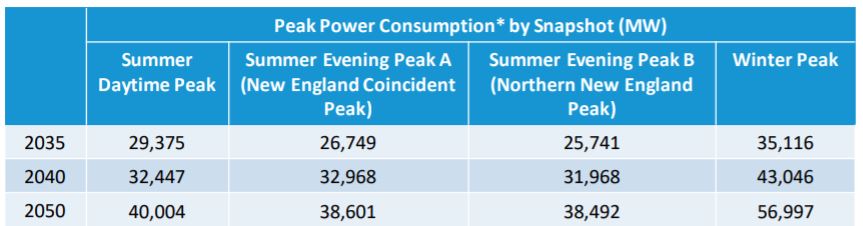
- Resource Modeling:
- Nuclear and biomass will
be assumed at 100% available for all 4 snapshots and all 3 study years.
- Hydro generator
dispatch in the summer peak snapshots will be consistent with ongoing
practice in Needs Assessments. Winter peak snapshots will be dispatched
based on historical outputs in 2019 under winter peak load conditions.
- Natural Gas will
be assumed at 100% availability for all 4 snapshots and all 3 study
years.
- Rooftop solar is
modeled as negative load for all rooftop solar PV and as generators for
all ground-mounted solar PV (GM PV). This study adopted the approach in
the Transmission Planning for the Clean Energy Transition (TPCET) Pilot
study (which ISO-NE initiated to update the assumptions used in
transmission planning studies under a 10-year timeframe and is still
ongoing), which mapped rooftop PV to cities and towns in New England by
substation. GM PV is modeled in this study based on existing and planned
resources in the 2031 NA Case, with the remaining GM PV distributed
evenly by state across transmission substations in New England in cities
and towns with a population density less than 3,000 per square mile.
Below is a summary of the assumed PV availability, developed in the TPCET
Pilot study by snapshot.
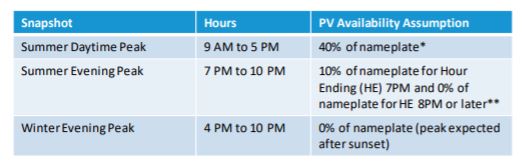
- Onshore wind generation is modeled from the "All
Options" pathway and 2031 NA case. Below is a summary of the assumed
onshore wind availability, developed in the TPCET Pilot study by
snapshot.
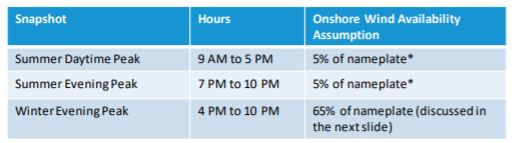
- Offshore wind (OSW) is modeled from the "All Options"
pathway and 2031 NA case. New additional offshore wind units will be
interconnected to 345 kV stations or major 115 kV stations. The maximum
size for a single OSW plant is assumed to be 1,200 MW, with no more than
2,400 MW of OSW being interconnected to the same bus. Below is a summary
of the assumed offshore wind availability, developed in the TPCET Pilot
study by snapshot.
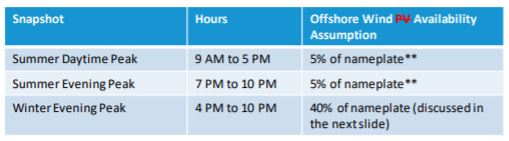
- Energy Storage is modeled from the "All Options"
pathway and 2031 NA case. All planned battery energy storage systems in
the 2031 NA case were assumed to have 2 hours of storage. For this study,
planned future storage not modeled in the 2031 NA case will be modeled as
4 hours of storage, consistent with the assumption for new battery
storage in the FGRS Scenario 3, and will be located at major 345 kV
stations or at generator stations with expected retirements. The
availability of pumped storage hydro will be similar to that of
batteries. Below is a summary of the assumed energy storage availability,
developed in the TPCET Pilot study by snapshot.
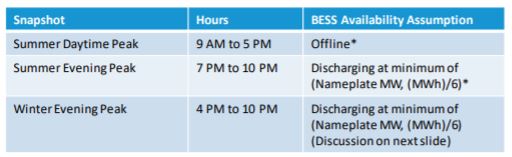
Resource Adequacy: To perform a transmission
planning study there must be sufficient capacity resources, which is not the
case in several of the snapshots. To address this resource insufficiency, the
2050 Transmission study added proxy generators at offshore wind locations in
proportion to the size of the wind farm for these snapshots. For the snapshots
where there was sufficient resource adequacy, excess resources were assumed to
be curtailed, in order, from imports on the NY-NE AC ties, natural gas combustion
turbines (CT), and natural gas combined cycle combustion turbines (CCGT).
The 2050 Transmission study will perform the initial analysis and
identify thermal violations, after which it will evaluate transmission upgrades
and estimate the associated costs
Vineyard Wind breaks
ground on Vineyard Wind I project
On November 18, 2021, Vineyard Wind (a joint venture between
Avangrid Renewables and Copenhagen Infrastructure Partners) broke ground on
the Vineyard
Wind I offshore wind project. Initial construction steps will
include laying the two transmission cables that will connect the project to the
mainland at Barnstable, MA, according to the Department of the Interior’s press release. As discussed in Digest 88, the
Bureau of Ocean Energy Management issued its Record of Decision approving the
Construction and Operations Plan for the 800 MW Vineyard Wind I project earlier
this year, and the project is anticipated to begin delivering power to
Massachusetts in 2023. Vineyard Wind’s press release about the groundbreaking
notes that the project will consist of 62, 13 MW General Electric Haliade-X
wind turbines. Vineyard Wind was selected to enter into power purchase agreements
with Massachusetts electric distribution companies as part of Massachusetts’
Section 83C solicitation in 2018.
Solar Trade Updates:
Federal trade court strikes down tariff on bifacial solar and reinstates
exclusion; International Trade Commission recommends that Biden Administration
extend of solar panel tariffs
On November 16, 2021, the U.S. Court of International Trade (CIT)
issued a ruling, reinstating the bifacial solar module
tariff exclusion to the Section 201 global safeguard tariffs on solar cells and
modules. The CIT ruling also reduced the Section 201 tariff rate back to 15%
after President Trump raised it to 18% in 2020 (discussed below). While the
ruling was criticized by some domestic solar manufacturers, the Solar Energy
Industries Association’s (SEIA)president and CEO commended the ruling as
“clearly the right decision.” On November 24, the U.S. International Trade
Commission (ITC) recommended an extension to the Section
201 solar cells and modules tariffs, leaving the final decision to President
Biden. The ITC argued that the U.S. solar panel manufacturing industry
continues to need protection while it continues to make positive adjustments to
import competition. Bifacial panels will still be excluded from the tariff if
the extension is granted. As discussed in Digest 85, on October 10, 2020,
President Trump issued a proclamation directing the U.S. Trade Representative
(USTR) to reinstate Section 201 tariffs on bifacial panels in a continuation of
the Administration's attempt to withdraw an exclusion for this type of panel.
As discussed in Digest 86, on November 19, 2020, Judge Gary Katzman of the U.S.
CIT issued an Order, lifting a Temporary Restraining Order on President
Trump's presidential proclamation, and allowing the
USTR to remove the tariff exemption for bifacial solar panels. This led to a
lawsuit from three solar developers and SEIA, who argued that Trump’s
proclamation violated trade laws. In March 2021, the Biden administration asked
a federal judge to dismiss this challenge to Trump’s tariffs, arguing that
Trump “acted lawfully and fully within his authority” in reinstating tariffs on
bifacial solar. The ITC will be forwarding its full report on the issue to
President Biden by December 8, 2021.
Illinois regulators
begin implementation of CEJA provisions, including provisions related to energy
storage, electric vehicles, and REC procurement
Illinois regulators have taken the first steps towards
implementation of the recently enacted omnibus energy legislation known
as The Climate and Equitable Jobs Act (CEJA). The
Act contains a wide range of provisions, including wind and solar development,
public utility company ratemaking and operations, and emissions and efficiency
standards at coal- and gas-fired power plants. Per a summary distributed by law
firm Quarles & Brady Initial actions in response to CEJA’s provisions
include the following:
- The Illinois Commerce Commission (ICC) has:
- Initiated a competitive selection process for experts
to support the development of a Renewable Energy Access Plan, which will
determine zones throughout the state that could support renewable energy
facilities and propose transmission solutions;
- Commenced formal workshops to identify and measure
energy storage costs, benefits and barriers;
- Invited stakeholders to participate in an
Interconnection Working Group;
- Created an application for customers with
high electricity usage to opt-out of utility energy efficiency programs
and develop their own plans;
- Hired a facilitator for “Beneficial Electrification”
workshops (next one is set for December 15, 2021) that will focus on
electric vehicle (EV) related topics; and
- Initiated a competitive selection process for a
facilitator to lead Integrated Grid Plan workshops.
- The Illinois Power Agency (IPA) has:
- Issued draft
revisions to the standard form REC contract for the
Adjustable Block Program (ABP) for community solar and small and large
distributed generation (DG) solar projects, in response to the CEJA
effectively doubling the state’s investment in renewables through an
increase in REC procurement requirements; and
- Issued a request for stakeholder feedback on
its Long-Term Renewable Resources Procurement Plan, which covers
“utility-scale projects, the ABP, and the Illinois Solar for All Program
applicable to low-income projects.”
CEJA’s overall objective is to put Illinois on track to reach 100%
carbon-free energy by 2050.
DOE issues RFI on energy sector supply chain
On November 29, 2021, the U.S. Department of Energy released a Request for Information on supply chains
in the energy sector. The RFI is issued in accordance with Executive Order 14017, which required the
Secretary of Energy to submit to the President a report on supply chains for
the energy sector industrial base. The RFI seeks responses to numerous
questions regarding supply chain development across the following topics:
- Crosscutting topics relating to
the energy sector industrial base
- Solar PV Technology
- Wind Energy Technology
- Energy Storage Technology
- Electric Grid - Transformers
and HVDC
- Hydropower and Pumped Storage
Technology
- Nuclear Energy Technology
- Fuel Cells and Electrolyzers
- Semiconductors
- Neodymium Magnets
- Platinum Group Metals and other
materials used as Catalysts
- Carbon Capture, Storage, and
Transportation Materials
- Cybersecurity and Digital
Components
- Commercialization and
Competitiveness
Interested stakeholders can submit comments here, and the comment deadline is 5:00pm
on January 15, 2022.
Other Regional and National
News of Note
- Vestas announces modular nacelles for offshore wind
turbines: On November 17, 2021, wind
energy manufacturer Vestas announced the introduction of a
modularized wind turbine nacelle design as a step towards reaching full
wind turbine modularity. The new nacelle design takes general industry
logistics standards into account, allowing them to be transferred with
less specialized handling needed. Vestas is promoting a “simple click-on
system,” which allows for easy servicing and upgrade possibilities over
the lifetime of the system. The modular nacelle is already in use in
Vestas’ V236-15MW turbine and will be utilized in future turbine variants.
- Gas Utility Symposium set for December 7 and 8: The Brattle Group is holding a virtual Future of Gas Utilities Symposium on December
7 and December 8, 2021. The Symposium will explore the role that
natural gas utilities can play in the transition towards decarbonization,
featuring experts from across the country. Those interested in
participating can register for day one and day two.
- FERC and NERC researchers release Report on Texas power
outages; Provide 28 recommendations for future prevention: A team made up of staff from the FERC, the North
American Electric Reliability Corporation (NERC), Regional Reliability
Entities Midwest Reliability Organization (MRO), Northeast Power
Coordinating Council (NPCC), ReliabilityFirst Corporation (RF), SERC
Corporation (SERC), Texas Reliability Entity (Texas RE) and Western
Electricity Coordinating Council (WECC), as well as the U.S. Department of
Energy and the National Oceanic and Atmospheric Administration (NOAA),
have released a joint report entitled “The February 2021 Cold Weather Outages in Texas and
the South Central United States.” The report provides an
exhaustive timeline on the events in February 2021 that led to power
outages across Texas and other southern states, and offers explanations
and recommendations based on the analysis of the event. The Report found
that 49 generating units (15% or 1,944 MW of nameplate capacity) in the
Southwest Power Pool (SPP) and 26 units in ERCOT (7% or 3,675MW) did not
have any winterization plans. Freezing issues caused 44% of unplanned
outages, while fuel issues caused 31%. Wind turbines experienced 117
outages between SPP and ERCOT, with freezing being the main issue 98% of
the time. The report issued a total of 28 key recommendations to prevent
future widespread outages, including:
- Revising the mandatory Reliability Standards to
require steps such as retrofitting existing generation units to operate
in colder temperatures, conducting annual trainings on winterization
plans, and determining the percentage of total generating capacity that
can be relied upon during cold weather events;
- Requiring natural gas facilities implement cold
weather preparedness plans;
- Creating a forum led by FERC to identify actions to
improve the reliability of the natural gas infrastructure system;
- Analyzing behind the meter (BTM) intermittent
generation effects to improve load forecasts; and
- Deploying demand response measures and energy
efficiency incentives.
- NERC releases Winter Reliability Assessment; Identifies
New England as region with high risk:
On November 22, 2021, the North American Electric Reliability Corp. (NERC)
released its 2021-2022 Winter Reliability Assessment.
The Report found that regions vulnerable to extreme weather, natural gas
supply disruptions, and low hydro conditions are facing elevated
reliability risk this winter, and recommended proactive steps for extreme
weather operation. The Assessment identified New England as one region
with elevated risk, because its natural gas transportation infrastructure
can be constrained in times of peak demand for generation and consumer
heating needs. New England also competes for liquefied natural gas supply
on the world market, and this winter is anticipated to bring an
unprecedented demand for liquefied natural gas. NERC recommended that
stakeholders review NERC’s Generating Unit Winter Weather Readiness Guideline.
They also advised balancing authorities to poll the generating units periodically
and in advance of severe weather to better understand their readiness
level, and to work with reliability coordinators to conduct drills on
alert protocols. Finally, they recommended that distribution providers and
load-serving entities review rolling blackout procedures and non-firm
customer inventories to ensure that critical infrastructure loads are not
affected. ISO-NE subsequently issued a press release in which they shared
concerns that “fuel supply issues may threaten ability to meet consumer
demand if the region sees extended periods of extreme cold weather.” While
ISO-NE expects to have sufficient supplies if the winter is mild, they
cautioned that an extended cold snap could put the region in a perilous
position.
- First Solar signs deal with Lightsource bp and bp for
5.4 GW of solar panels: On
November 22, 2021, U.S.-based solar panel manufacturer First Solar announced that solar company
Lightsource bp and energy company bp have ordered 5.4 GW of their panels
for delivery between 2023 and 2025 (firm orders for 4.4 GW and options for
an additional 1 GW). The deal is for First Solar’s “ultra-low carbon thin
film solar modules.” Jeff Dennis, managing director and general counsel
for Advanced Energy Economy, noted that this may be a precursor to more
solar developers stocking up on essential supplies ahead of increased
demand from favorable government policy and price volatility in
traditional energy sources.
- New report projects 500,000 new jobs will be created by
microgrid expansion by 2030:
A new report from Guidehouse found
that by 2030 renewable microgrids in the country will generate half a
million new jobs, $72 billion in GDP growth, and $146 billion in sales
across the supply chain. The study assumed that 32 GW of microgrids will
be installed by the end of the decade.
- MIT researchers find new semi solid flow battery
solution that could compete with lithium-ion technology: Researchers at the Massachusetts Institute of
Technology (MIT) have announced a new energy storage
technology called a semi solid flow battery, which they claim will be a
cost-competitive form of energy storage that can complement variable
renewable energy sources including wind and solar. Their solution utilizes
cheaper chemical components than other flow battery systems, and has beat
out lithium-ion batteries and vanadium redox flow batteries in tests where
batteries are discharged longer than a day.
- New storage study finds that ConnectedSolution payments
should be increased: According
to a new report from the Applied
Economics Clinic (AEC) and the Clean Energy Group (CEG), customer-sited
battery storage is by far the cheapest new winter peaking resource
available to Massachusetts utilities. The report found that payments to
customers in the ConnectedSolutions demand response program should be
increased by at least 33%, and program budgets should be expanded
immediately to reflect their efficacy. Winter electric peaking capacity,
the report adds, is vital for the grid because it helps to prevent winter
blackouts.
Best regards,
The SEA Team
 Sustainable Energy Advantage, LLC
Jim Kennerly – Director, Policy Analytics Practice Lead
Tel. 508-665-5862 | jkennerly@seadvantage.com

 Connect with SEA!
Eyes & Ears
Terms and Conditions
Eyes & Ears Service is provided to the Subscriber for the Subscriber’s
internal use only, and may be distributed to employees, officers and directors
of Subscriber or Authorized Affiliate who have been made aware of the
Limitations on Use under the Subscription Agreement. Subscriber agrees
not to distribute materials received under the Eyes & Ears Service,
whether by written, oral or electronic means, to any other person, including
consultants engaged by Subscriber, except with specific written permission from
SEA or as required by applicable law, regulatory proceeding or exchange rule.
Subscriber is subject to additional terms and conditions stated in the
Subscription Agreement.